
Best Amiri Reps on Kakobuy
Almost everything Amiri makes is sold to you pre-aged. The cotton is faded like a shirt left on a car seat for a summer, the logos are cracked as if they had been washed two hundred times, the denim arrives already worn through at the knee and patched back together. That is the house style, and it changes what a good copy even means. Making something look new is easy and free. Making something look old costs extra process — garment dyeing, enzyme washing, sanding, hand-placed repairs — and process is the first thing a cheap factory quietly deletes. Which gives this brand a failure mode you will not find anywhere else on this site: a bad Amiri rep does not look sloppy, it looks new. This guide ranks the Amiri pieces worth buying on Kakobuy Drop — from $14.24 — then shows you how to read the fade, what the brand's own care label admits about its originals, and which of its four signature looks survives the trip and which does not.
Which Amiri reps are actually worth buying?
Ranked by price, cheapest first. Every piece below was checked live before publishing, and every one was identified from its own product photograph rather than its listing title. That step matters more here than usual: this catalogue files several genuinely different brands under the word "Amiri", and one listing labelled as a sneaker turned out to be a pair of jeans. Everything in this table is the real thing it says it is.
| Pick | Type | Price |
|---|---|---|
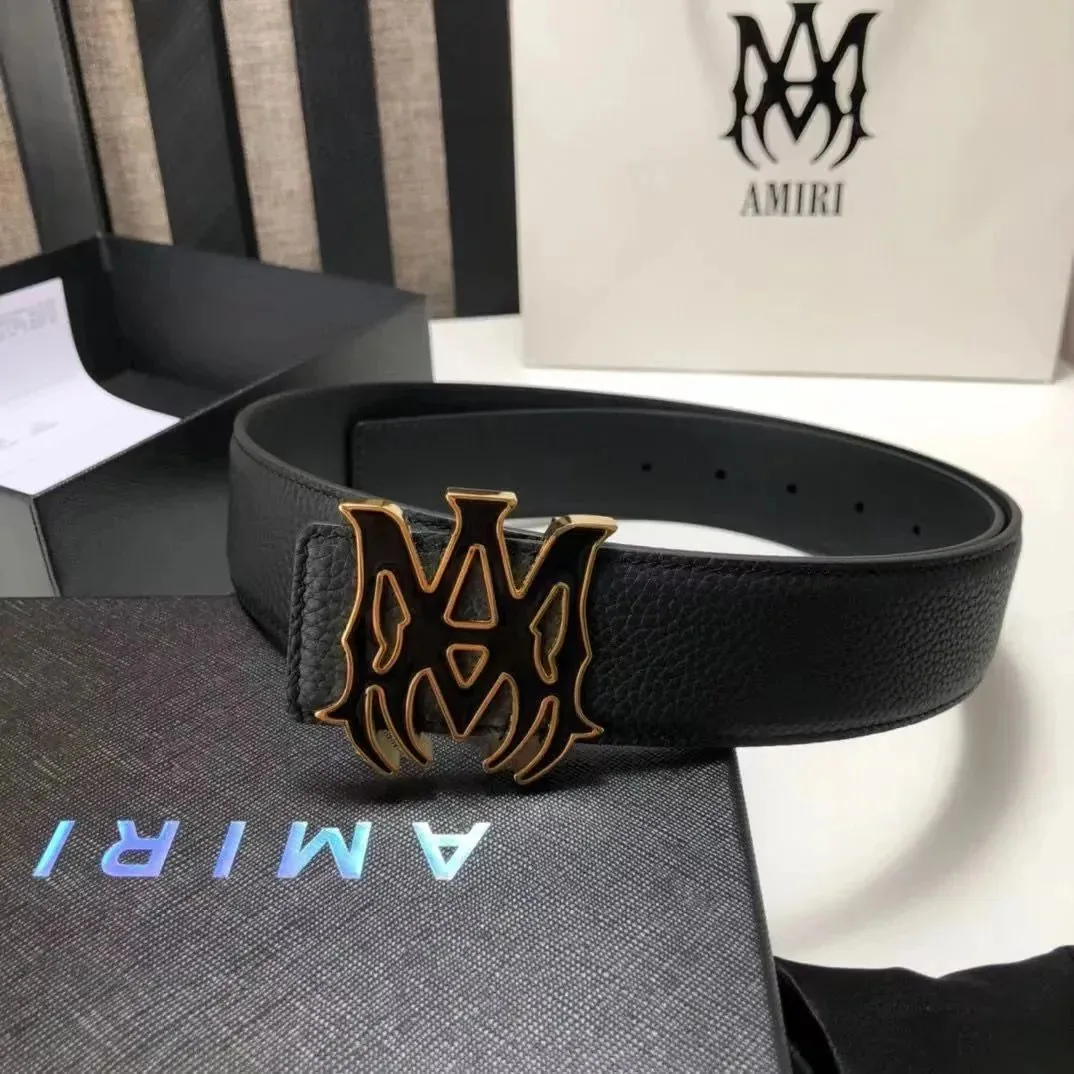
| Pebbled Leather Plaque Belt | Belt | $14.24 |
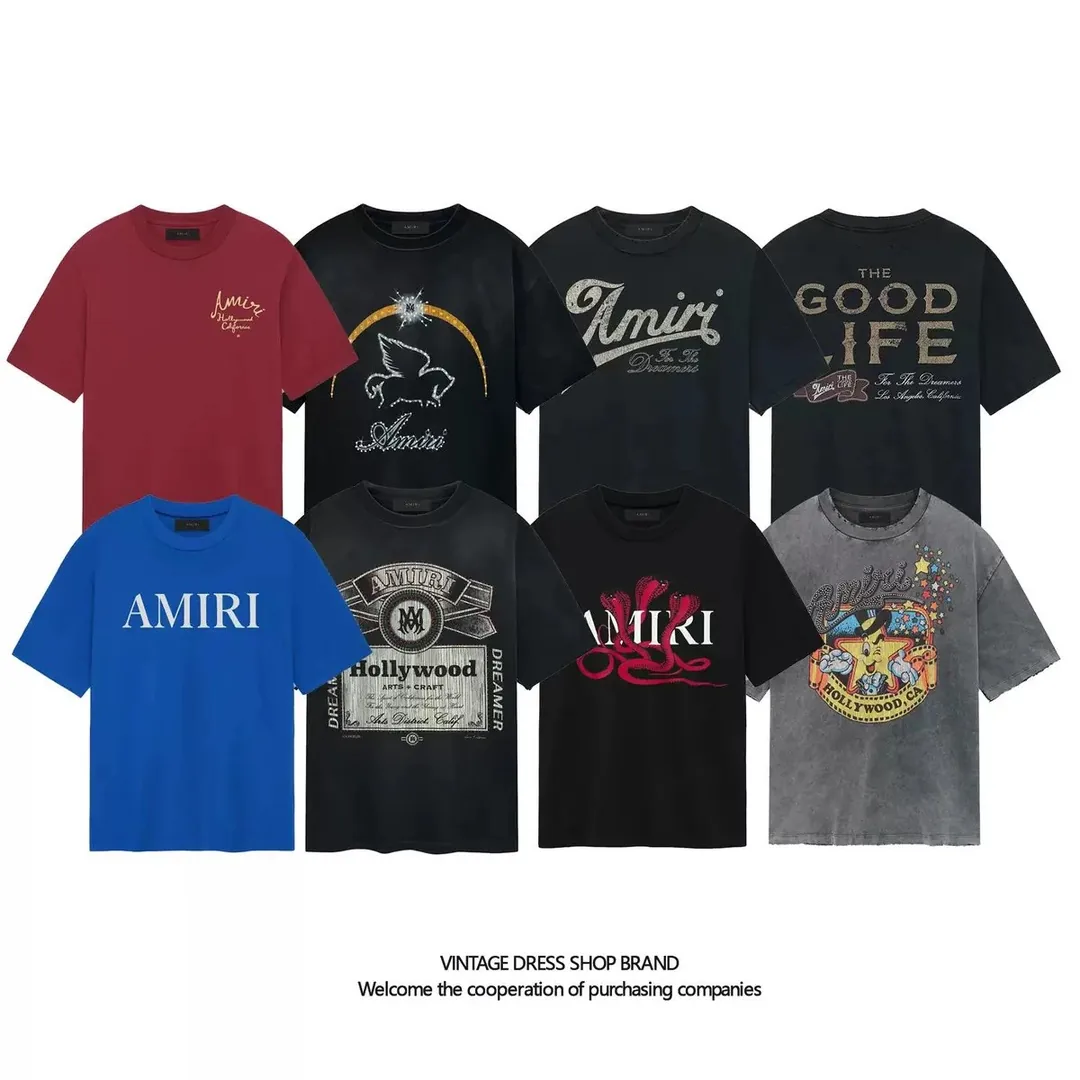
| Vintage-Washed Hollywood Graphic Tee | Tee | $15.66 |
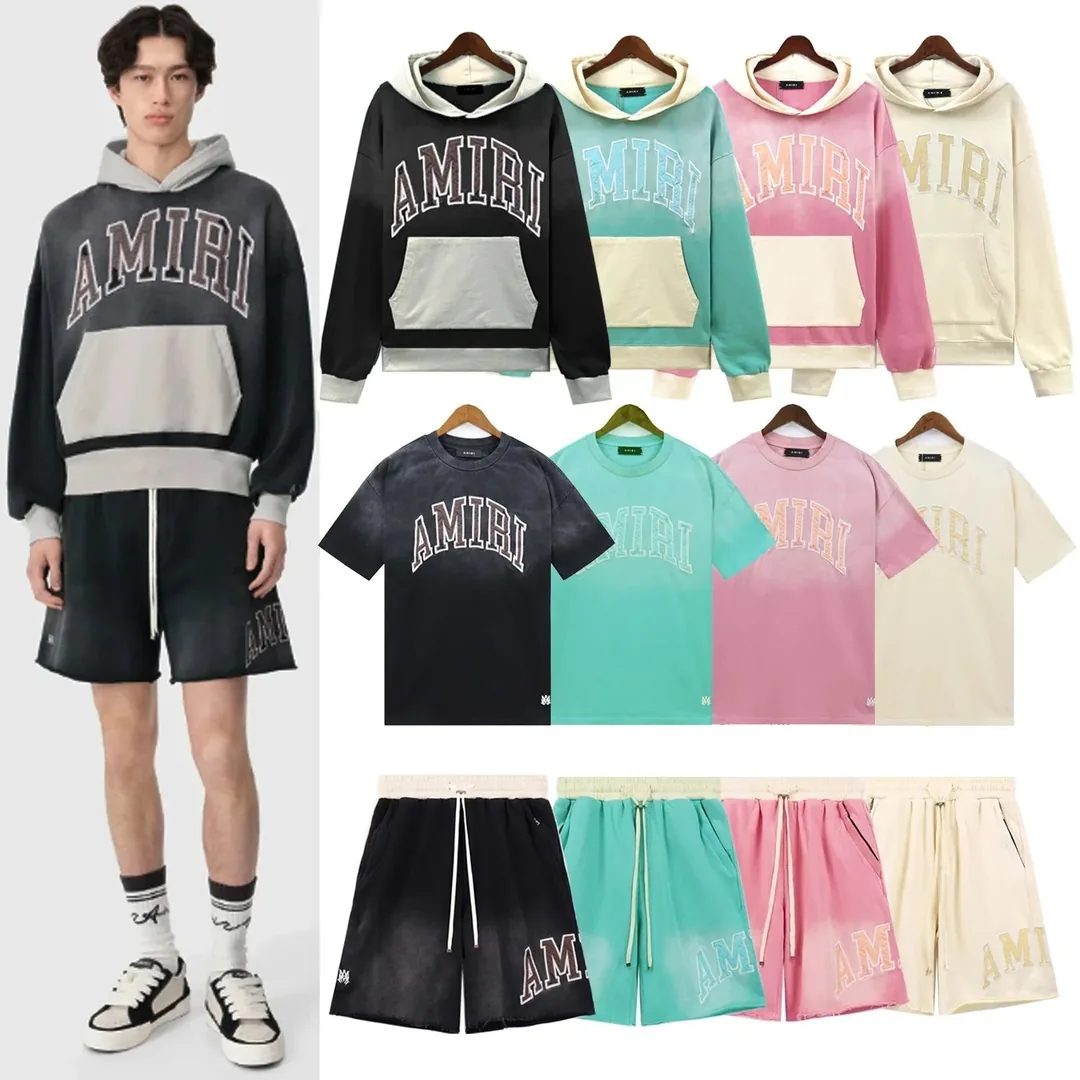
| Sun-Faded Tee & Shorts Set | Set | $20.67 |
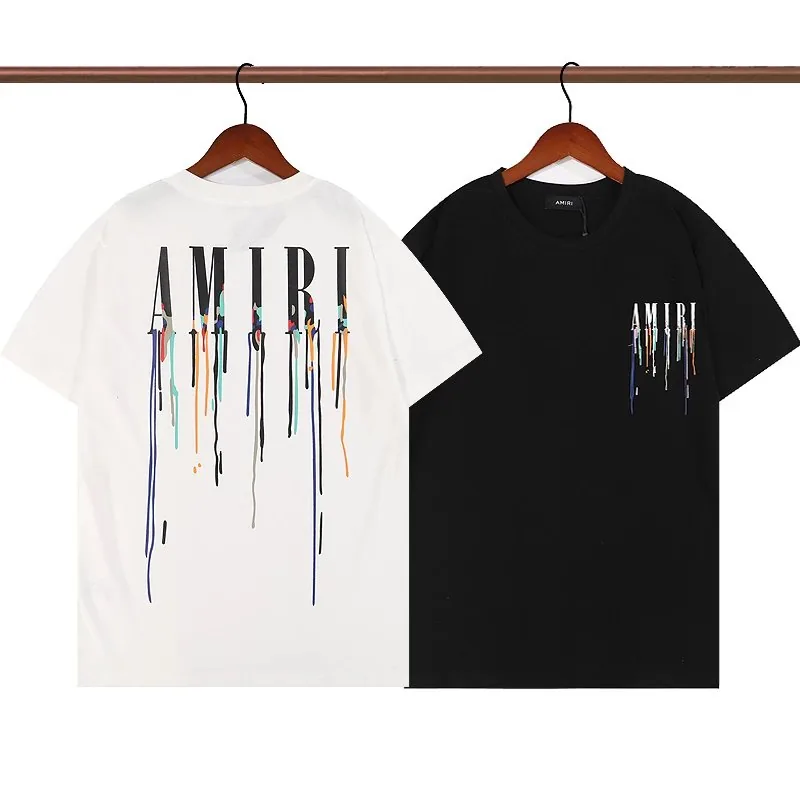
| Paint-Drip Logo Tee | Tee | $21.04 |
| Washed Embroidered Cotton Tee | Tee | $23.97 |
| Distressed Letter-Appliqué Jeans | Denim | $28.60 |
| Crackle-Print Logo Hoodie | Hoodie | $28.76 |
| Paint-Drip Logo Sweatshirt | Sweat | $29.88 |
| Repair-Patch Distressed Jeans | Denim | $31.96 |
| Reversible Letter-Plaque Belt | Belt | $43.15 |
| MA-1 Style Sneakers, White | Sneaker | $73.83 |
| Chenille-Embroidered Varsity Jacket | Jacket | $74.79 |
The same MA-1 silhouette is also in stock in black and white at $74.95 if you would rather not own a white sneaker. Browse the rest of the tops and hoodies catalogue for more of the same washed-jersey category.
Prices are the live Kakobuy Drop prices at the time of writing and move with the catalogue. Brand names describe the style a piece is modelled on.
The brand's own label tells you the piece will vary
This is the single most useful thing to know before you judge an Amiri rep, and it comes from Amiri rather than from us. On its cotton pieces, the care information states that the garment has undergone a special process which results in — the brand's own words — "intentional variations of shading and color", and then adds that this may lead to bleeding or dye transfer.
Read that again with a QC photo in front of you. A $490 tee is sold with a written warning that its colour will not be uniform and might come off on other things. Which means:
- "It doesn't look exactly like the listing photo" is not a defect on this brand. On a football shirt, a crest one centimetre off is a fail. Here, the fade landing differently is what the original does too. Judge the character of the wash, not its exact placement.
- Wash it cold, inside out, on its own the first time. Dye transfer is a property of heavily treated garment-dyed cotton, not a sign that you bought a bad copy.
- But absence of variation is a real fail. If the "fade" is a perfectly repeating gradient with hard edges, sitting on fabric that is otherwise flat and bright, the factory printed the effect instead of running it. That is the tell, and it is visible in a photo.
Elsewhere in the same product copy, Amiri describes pieces as treated for a sun-faded effect and graphics applied in a distressed treatment. The wear is a specified, priced-in production step. It is not incidental to the product — on most of this line, it is the product.
Why a $330 t-shirt looks like it has been washed two hundred times
The house codes make more sense once you know where they came from. Mike Amiri was born in 1976 and raised in Hollywood; he worked in the music industry before turning to designing handcrafted stage clothing for musicians, one piece at a time, with the kind of customisation that later became the brand's vocabulary. In 2014 he released a debut menswear capsule for the Los Angeles concept store Maxfield, and launched AMIRI on the back of it the same year. It showed at Paris Fashion Week for the first time in 2018, took a minority investment from Renzo Rosso's OTB Group in 2019, opened its Rodeo Drive flagship in 2020, and now sells through more than 160 retailers including Bergdorf Goodman, Harrods and Selfridges.
That history explains the aesthetic precisely. A designer who built one-off stage clothes by hand is going to make a brand whose signatures are hand-shaped: abrasion, repair, paint, patchwork. Not one of those codes is a shape or a silhouette you could sketch — they are all treatments. And treatments are the part of a garment that costs labour rather than design.
This is worth saying plainly because it is where our advice on this brand diverges from the rest of the site. On Essentials we said the minimal tonal look is the hardest rep to spot, because there is nothing to get wrong. Amiri is the exact inverse: maximal, loud, instantly recognisable across a street — and therefore easy to spot but genuinely hard to make. On caps the whole judgement was embroidery density. On belts it was a cast metal buckle. On sunglasses the risky half was the part no photograph can show. Here, everything is visible — and the thing you are checking is whether a process happened at all.
The four Amiri looks, and how each one fails
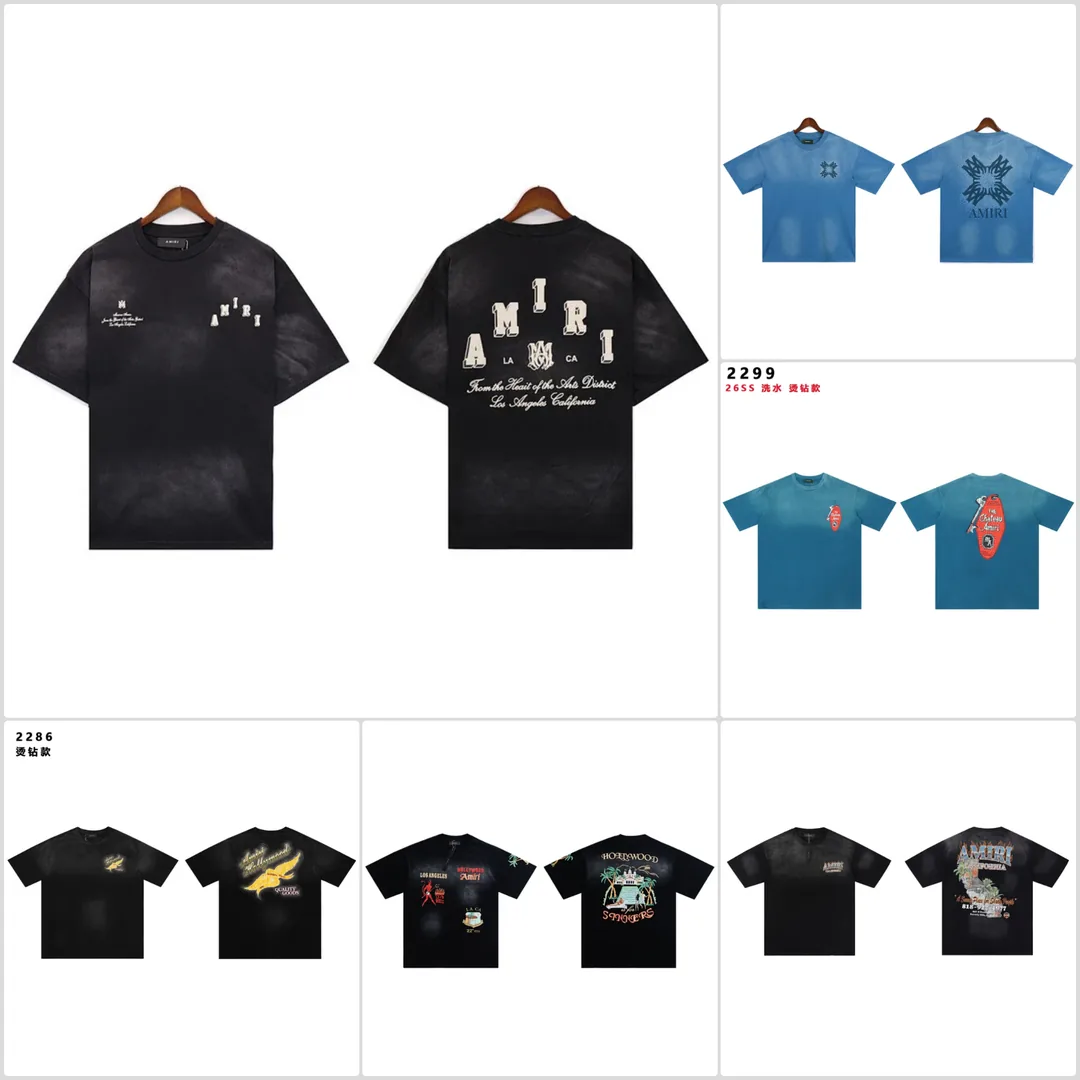
- The washed graphic tee — reps closest. This is the entry point and the safest buy. The vintage-washed Hollywood tee at $15.66 is the template: a heavy label-style graphic printed with deliberate cracking, on cotton dyed down to a soft, uneven black. The sun-faded tee and shorts set at $20.67 is the same idea across two pieces, with the fade running vertically from the shoulders down and arch lettering applied as appliqué rather than print. What to check in the QC photo: does the dark colour break up over the body, or is it uniform? Is the print cracked irregularly, or in a repeating pattern? Does the appliqué have raised edges and visible stitching, or is it a flat transfer pretending to be one?
- The paint-drip and crackle logo — check the technique, not the shape. The crackle-print logo hoodie at $28.76 covers the whole body in a fine black craquelure with a clean serif logo over it, and the paint-drip sweatshirt at $29.88 has the stacked letters bleeding coloured runs down the chest. On the good version of the drip, those runs are embroidered — you can see thread direction and slight relief in the photo. On the cheap version they are a flat single-pass print. This is the one Amiri code where the difference between a $30 piece that reads right and a $30 piece that reads wrong is entirely a technique you can see, so it is worth zooming.
- The distressed denim — the real thing, and the hardest to reproduce. The distressed letter-appliqué jeans at $28.60 and the repair-patch pair at $31.96 are the closest this catalogue gets to what the house is actually known for: heavy whiskering, sanded thighs, blown-out knees backed with contrast panels, tonal letter appliqué down the leg. They are also where the gap is widest, because placed abrasion and repair work is labour, and labour is what a four-figure pair of jeans buys — the MX1, the repair-panel jean this house was built on, is $1,090 in almost every wash it comes in. Judge them on the fade first — real garment abrasion is soft-edged and follows where a body creases; printed fade is symmetrical and sits in the same place on both legs. Then check the rivets and the back-pocket stitching, which are the two things factories rush.
- The MA-1 sneaker — the exception that breaks the rule. The one product line where Amiri sells you something brand new looking. The white MA-1 style pair at $73.83 is a chunky, layered leather low-top with a segmented midsole and the MA monogram on the panel. Nothing about it is a finishing question, so ignore everything above and judge it the way you would judge any reps sneaker: panel alignment, how cleanly the mesh sits behind the cut-outs, whether the midsole layers are even on both shoes, and glue at the edges. It is also the biggest single price gap in this guide, because the original is $850.
What you're actually saving — and why the floor matters more
Every figure below is from Amiri's own current product feed, checked the day this page was written. Where we could not verify something officially, it is not here.
- Tees: $330 to $790. The cheapest garment Amiri sells is the $330 script tee; the MA tee is $350, the MA Skater $490, the Bandana Patch $590, the tie-dye $790. Our washed graphic tees are $15.66 to $23.97.
- Hoodies and sweatshirts: $510 to $2,390. The Bones stacked hoodie is the entry at $510, the core MA hoodie $690, the MA Core Logo $750, the oversized $770, the Bones oversized $990. Our crackle hoodie is $28.76.
- Sneakers: $450 to $1,490, with the MA-1 at $850. The Skel Top Low and Stars Court Low are $650, the MA Skyline $790 to $820, the crystal MA-1 $1,490. Our MA-1 style pair is $73.83.
- Denim: $750 to $4,490. The Stack jean is the entry at $750, the straight flare $790, and the signature MX1 — the repair-panel jean the house is built on — is $1,090 across almost every wash, rising to $1,490 for the cargo and $2,090 for the crystal version. Our two distressed pairs are $28.60 and $31.96.
- Outerwear: $850 to $3,990, and the varsity jacket is $2,090. The track jacket is $850, the Bones down jacket $1,390, the MA blouson $1,590. Our chenille varsity jacket is $74.79 — the largest absolute gap on this page.
- Belts: $450 to $550. The MA Quad 4cm is $450, the Core Logo $490, the chain belt $530. Our plaque belt is $14.24.
Ratios are not really the interesting number, though. Look at the floor instead. Across the brand pages on this site, the originals have an entry tier: a Corteiz tee is £40, a Bape tee starts at $99, a Stussy tee is $45. There is a version of those brands a normal person occasionally buys. Amiri has no such tier at all — its least expensive item of clothing costs more than the most expensive item on most of our other brand pages. So the honest framing is not "save 95%". It is that for this particular label, the rep is not a discount on a purchase you were going to make; it is the only version of the purchase that exists at this budget. Decide how you feel about that before you order, because it is a different question from buying a $14 football shirt instead of a $110 one.
Sizing: two offsets stacked on each other
Amiri cuts relaxed and oversized by design — a large part of the current line is literally named "oversized" — and these reps are made to Asian sizing, which runs smaller than EU or US. Those two offsets pull in opposite directions, which is exactly why guessing a letter fails.
Do this instead, and it takes two minutes: take a t-shirt or hoodie you already like the fit of, lay it flat, and measure across the chest from armpit to armpit (double it for the full chest measurement) and from the collar seam straight down to the hem. Nearly every listing here includes a centimetre chart giving chest, length, shoulder and sleeve per size. Match your numbers to that chart and ignore the letter. On an oversized piece, when you are between two sizes, take the larger one — the look depends on the drop shoulder actually dropping. Our size guide walks through the same measure-first method in more detail, and the QC photos guide explains how to ask for a flat-lay measurement shot if the listing chart looks thin.
Where we'd spend real money instead
Every category guide on this site has a line where we say buy the real one. For tech that line was drawn on safety, for belts on arithmetic and durability. For Amiri it is drawn by which part of the garment carries the value, and it falls in one specific place: denim.
A washed tee is a graphic and a laundry process on 100% cotton, made in Italy or Turkey. A rep gets you the graphic and an approximation of the process, and what you give up is the hand of the cotton and the cut. That is a reasonable trade at $15.66 against $330. A pair of destroyed, patched, appliquéd jeans is the opposite: the fabric is the cheap part and the labour is the product — placed sanding, hand-set repair panels, and finishing decisions made pair by pair, which is the exact thing the brand grew out of. A $32 rep gives you the silhouette and the look from three metres. It does not give you the thing you were paying for.
So the fork we would actually take:
- Buy the reps for the washed tees, the shorts set, the crackle and drip sweatshirts, and the plaque belts. These are the pieces where a factory can genuinely reproduce most of what the original is, and where the price gap is absurd in your favour.
- Buy the reps knowingly for the MA-1 sneaker: at $73.83 against $850 it is the best-value item here, but a chunky leather sneaker is a construction product, so inspect it like one and expect a shorter life than the original.
- Think twice on the denim. If you want distressed jeans for a season and a look, they are $28.60 and they will do that job. If what you like about Amiri jeans is the craft, no rep at any price on this catalogue is delivering it, and we would rather tell you that than sell you the idea.
A note on trademarks
Amiri's value sits in registered marks — the MA monogram, the script wordmark, the letter plaque on the belts — in the same way it does on a cap and unlike the unbranded pieces we recommended in our bags guide. Customs authorities act on trademarks recorded with them, so a piece whose whole design is a wordmark carries a different risk profile from a plain garment. We describe these items as "-style" throughout because that is what they are, and none of the above is legal advice.
Ready to order?
- Pick your entry point. The washed Hollywood tee at $15.66 is the cheapest way to find out whether the finishing on this catalogue satisfies you, and the answer transfers to every other washed piece here.
- Measure a garment you own in centimetres and match the listing chart, rather than picking a letter. Size up when the piece is meant to be oversized.
- Click through to Kakobuy, or switch to any of the 15 agents we support from the product page.
- When the QC photo arrives, zoom three things: whether the fade is uneven and soft-edged, whether the print cracks irregularly, and whether the drip or appliqué is stitched rather than printed.
- Approve, pay shipping, and wash the first time cold, inside out and alone — the brand's own care copy warns about dye transfer on the originals.
New to agents? Start with how to use Kakobuy. For more in this vein, our reps t-shirts guide covers the cheapest way into designer graphics generally, reps hoodies ranks the wider sweatshirt field by brand, and the best Kakobuy finds page collects the strongest picks across every category. Since a tee and a belt together weigh almost nothing, the shipping guide shows how to combine them into one parcel.
Frequently asked questions
How much do Amiri reps cost on Kakobuy?
From $14.24 for a pebbled leather plaque belt to about $75 for an MA-1 style sneaker or a chenille varsity jacket, with the tees and sweatshirts — the bulk of what people actually want — landing between $15 and $32. The comparison that matters is not the discount but the floor. Amiri has no cheap tier: the least expensive garment on its own site is a $330 script tee, and the current men's line runs $330 to $790 for tees, $510 to $2,390 for hoodies and sweatshirts, $750 to $4,490 for denim, and $450 to $1,490 for sneakers, with the MA-1 at $850. Most brands we cover have an entry item somewhere near $45. Amiri does not, which is why the rep question here is less "how much am I saving" and more "is there any other way in".
What makes an Amiri rep good or bad?
Whether the factory actually ran the finishing process, or faked it. Almost every signature Amiri piece is sold in a state of manufactured age — sun-faded cotton, cracked prints, whiskered and repaired denim, paint-splatter graphics. Producing that costs extra steps: garment dyeing, enzyme or stone washing, sanding, hand-placed patches. Skipping those steps is the cheapest saving a factory can make, and the result is a piece that looks too clean — a sharp, evenly printed "faded" graphic sitting on flat, new-looking fabric, identical on every unit. So on this brand the failure mode is the opposite of every other category we write about: a bad Amiri rep does not look sloppy, it looks new.
Why does my Amiri piece not match the product photo exactly?
Because on this brand it is not supposed to. Amiri's own care information for its cotton pieces states that the garment has been through a process producing "intentional variations of shading and color", and warns that it may lead to bleeding or dye transfer. That is the $490 original talking about itself. It means two things for you. First, if your rep arrives with the fade sitting slightly differently from the listing photo, that is not a defect — the real one varies too. Second, wash it cold, alone, inside out the first time, because dye transfer is a property of the process rather than a sign of a cheap copy.
Which Amiri pieces rep best, and which rep worst?
Washed and printed jersey — tees, shorts sets, sweatshirts — rep closest, because the whole product is a graphic and a wash on cotton, and both are reproducible. The MA-1 style sneaker is next: it is a construction problem rather than a finishing problem, so the shape and the panelling either match or they do not, and you can see that in a QC photo. Distressed denim reps worst. That is where the original's money actually goes — placed abrasion, repair panels, bandana and letter appliqué, hardware — and where hand work is hardest to fake at volume. Buy the jeans if you want the look for a season. Do not buy them expecting the finish that costs four figures.
What size Amiri rep should I order?
Measure, do not guess. Amiri's own pieces are cut relaxed and oversized, and these reps are made to Asian sizing, so two separate offsets stack on top of each other. Almost every listing includes a centimetre chart — chest, length, shoulder, sleeve. Lay a garment you already like flat, measure it in centimetres across the chest and from collar seam to hem, and match those numbers to the chart instead of trusting a letter. When you are between two sizes on an oversized piece, take the larger. Our football jersey size guide explains the same measure-first method with a full chart if you want the longer version.
Are Amiri reps worth it compared to the real thing?
It depends entirely on which piece. For a washed graphic tee, a paint-drip sweatshirt or a plaque belt, a rep gets you most of the visual result for a fraction of a price that starts at $330, $510 and $450 respectively — and those categories are exactly where the original's value is a graphic and a laundry process rather than construction. For denim, the honest answer is different: a $32 pair of distressed jeans is a costume version of a $1,090 MX1 whose whole point is hand finishing, and you should buy it knowing that. Nothing here is an argument that the originals are overpriced — the brand shows in Paris, sells through Bergdorf Goodman and Harrods and has an OTB Group investment behind it. It is an argument about which parts of a luxury garment a factory can and cannot copy.