
Best Reps Shorts on Kakobuy
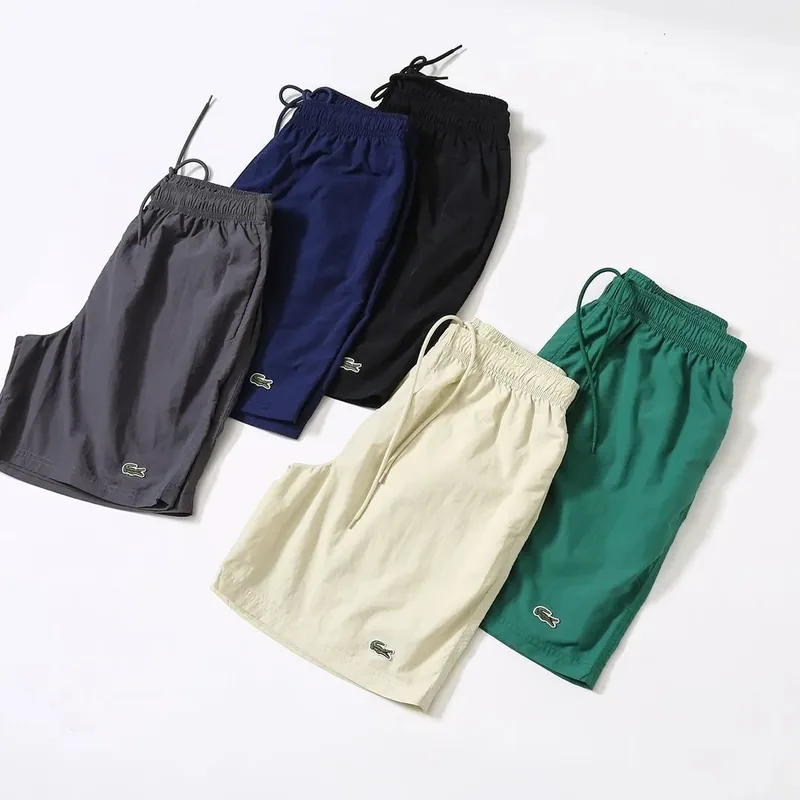
Shorts are the only thing you will buy from this catalogue where the photograph shows you the half that does not matter. The outside of a pair of shorts is a rectangle of fabric with a logo on it — the simplest pattern in garment-making and the easiest thing on earth to copy convincingly. Everything that actually costs money, and everything that actually goes wrong, is on the inside: the mesh liner, the inseam and rise, the pocket bags, and how much light the fabric lets through. A flat-lay QC photo, shot folded on a table under a ceiling light, misses all four. So the rule for this category is: judge the inside. This guide ranks the shorts worth buying on Kakobuy Drop — from $15.15 — then shows you the three photos to ask for, the sizing rule that matters, and the one type of shorts you should buy real instead.
Which reps shorts are actually worth buying?
Ranked by price, cheapest first. Every pair below was checked live before publishing, and the type of each one was confirmed from its own product photograph rather than its listing title — the titles in this category are close to useless, with entries like "Shorts", "shorts" and "Summer casual sports shorts 09" sitting next to each other in the same catalogue:
Browse more shorts and bottoms →
Prices are the live Kakobuy Drop prices at the time of writing and move with the catalogue. Brand names describe the style a piece is modelled on.
The liner is a component, and the brands price it as one
You do not have to take our word for the claim that the inside of a pair of shorts is the expensive part. Five separate brands say it themselves, in their own product names and their own price lists:
- Nike puts it in the title. The Miler Dri-FIT 7" is sold as a Brief-Lined running short at $42; the Form Dri-FIT 7" is sold as an Unlined versatile short at $47. Whether a short has a liner is considered important enough to be part of the product's name.
- Arc'teryx prices it directly. The Norvan Liner Short 7" — described on its own site as a "brief-lined trail-running short" — is $100. The Norvan Short 5", described as "linerless", is $90. Ten dollars, for the mesh.
- On builds a whole naming convention on it. Train Shorts 7" are $65; Train 2-in-1 Shorts are $75. The entry-level Core Shorts at $60 are described as having an "inner brief".
- The North Face charges $70 for the Wander 2-in-1 7", against $65 for the Class V Pathfinder and $50 for a Simple Dome short.
- Eric Emanuel, a brand that sells almost nothing but mesh shorts, splits its range the same way: the EE Basic Short is $98, and the EE Double Layer Short is $128.
Five brands, five price gaps, one component. Now put that next to how a rep is photographed. The standard QC set is two or three images of a garment folded flat on a table, front and back, plus a close-up of the logo. There is no angle in that set from which a liner is visible — which makes it the single easiest part of a pair of shorts to leave out without anybody noticing until the parcel arrives.
This is a different kind of blind spot from the ones covered elsewhere on this site, and the difference matters. When we say the lens is the invisible half of a pair of sunglasses, we mean invisible by physics: you cannot photograph UV transmission or optical grade, and no request to the agent will change that. The inside of a pair of shorts is invisible only by convention. It is right there. It just is not in the default photo set, and almost nobody asks.
The three photos to ask for
Ask before you approve QC, not after. All three are trivial for an agent to take and each one closes a failure you cannot otherwise see:
- The waistband turned inside out. This answers two questions at once. Is there a liner, and if so is it a proper brief with its own elastic, or a strip of mesh tacked to the waistband? And how is the drawstring anchored — a cord threaded through a channel with no bar-tack at the eyelets will pull through on one side the first time it goes in a machine, and then it is gone.
- A tape along the inside leg, and a second from the waistband top to the crotch seam. That gives you the inseam and the rise. See the sizing section for why these two numbers, and not the waist, are the ones that decide whether the shorts get worn.
- A pocket pulled inside out. Pocket bags are the cheapest place in the whole garment to economise, and it is invisible from outside. What you want to see is a bag deep enough that a phone sits below the opening, in a fabric with some body to it. Gauze-thin pocketing, shallow bags and a raw unfinished edge inside are all signs that the corners were cut in the places the camera never goes.
A fourth is worth asking for on any light colour: the fabric held up against a window. Shorts are worn in summer, in the brightest light of the year, and a flat-lay under a ceiling lamp is precisely the condition in which nothing looks see-through. One backlit photo settles it.
Sizing: the waist fixes itself, the length does not
Almost every pair on this page has an elastic waistband and a drawstring. That combination is genuinely forgiving — it absorbs two or three sizes of error, which is why waist is the least of your problems here. It is the same structural logic as a belt, the only other category on this site where a sizing mistake is recoverable: on a belt you trim the strap, on a pair of shorts the drawstring does the trimming for you.
What is not recoverable is the length. You cannot shorten a pair of shorts without cutting off the hem, and on most of the picks here the hem is the design — the raw edge on the terry shorts, the taped hem on the mesh pair, the side split on the running shorts. Take that off and you have a different garment. So the two numbers that matter are the inseam (how far down the leg it sits) and the rise (how high it sits on you, which is what actually decides whether the inseam reads as long or short on your body).
Here is the trap. Chinese size charts almost always give 裤长, meaning total length measured from the top of the waistband down — not the inseam. Total length includes the rise, so a chart that says 48cm is not describing a 48cm inseam; on a typical mid-rise short it is closer to a 20cm one. Two ways to handle it:
- If the chart gives both a rise (立裆 or 前浪) and a total length, subtract one from the other and you have an approximate inseam.
- If it gives one number only, measure a pair you already like the same way — waistband top to hem, flat — and match that number. Comparing like with like beats guessing at a conversion.
And when you are between sizes, go up. A short that sits slightly long can be worn; one that sits high on the thigh when you did not want it to cannot be fixed.
What to buy, by type
Sweat and fleece — the safest shorts to buy as a rep
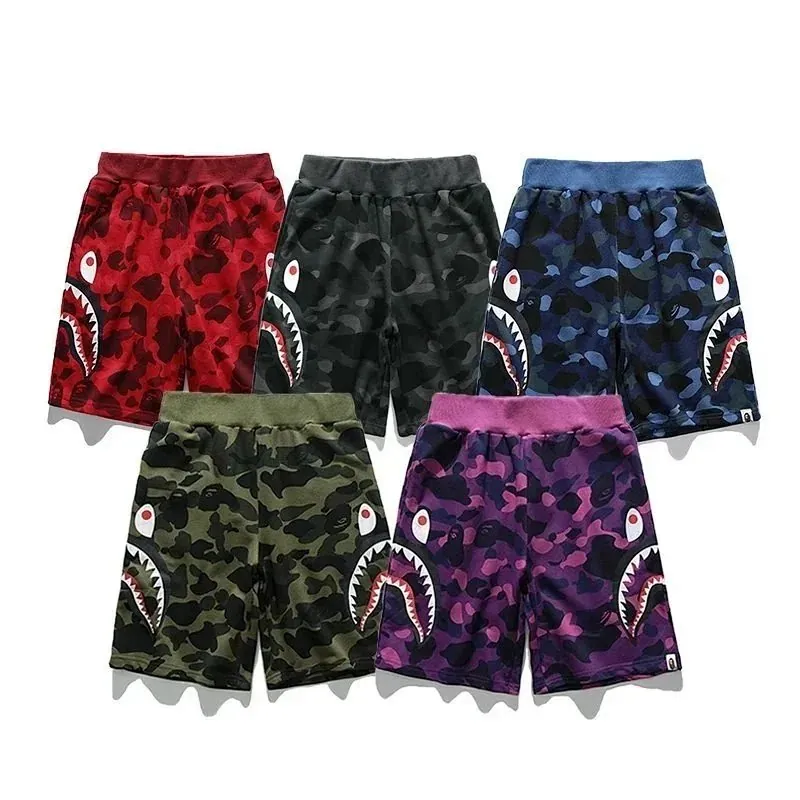
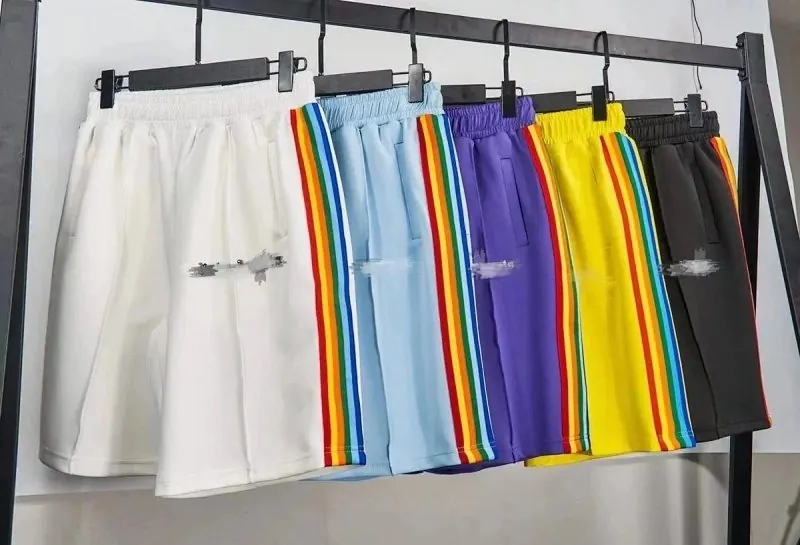
This is the type with the least that can go wrong. There is no liner to delete, no technical claim to fall short of, and a heavier loopback or fleece-back knit covers the two cheapest failures at once: it is not thin enough to be see-through, and the weight of the fabric hides mediocre overlocking. It is also where the price gap is at its most dramatic. The camo shark-print sweat shorts at $15.15 correspond to a product BAPE sells as the Color Camo Shark Sweat Shorts at $289 — the largest multiple on this page by a distance, roughly nineteen to one. The "1977" heavy jersey shorts at $26.65 sit against a Fear of God Essentials Classic Sweatshort at $90, which is the single most repeated price in that brand's shorts line. The star-graphic fleece at $23.97, the rainbow side-stripe track shorts at $20.13 and the swoosh-embroidered fleece at $35.16 are the same bet in different graphics — and against Nike's own Tech Fleece short at $100, that last one is still a three-to-one saving.
Mesh and basketball — where the liner question is the whole question
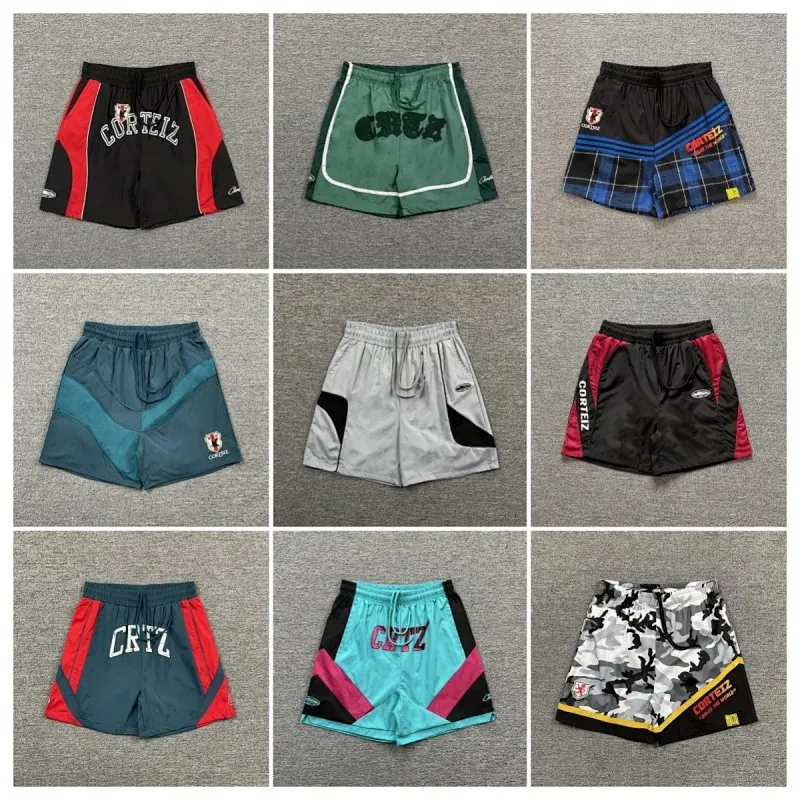
Mesh is supposed to be open; that is the point of it. Which means the liner underneath is not a comfort feature here, it is the reason the garment is wearable in public. The double-layer mesh pair at $57.53 is the one on this page where you can see the second layer in the product photograph, at the hem — and it is worth knowing that the brand this style comes from prices exactly that difference at $30 ($98 basic, $128 double layer). The panelled basketball shorts at $19.18 come in nine colourways and are the cheap way into the look; ask for the inside-out waistband shot on that one specifically, because at that price the liner is the first thing a factory drops.
Technical and performance — the riskiest type, and the one to think hardest about
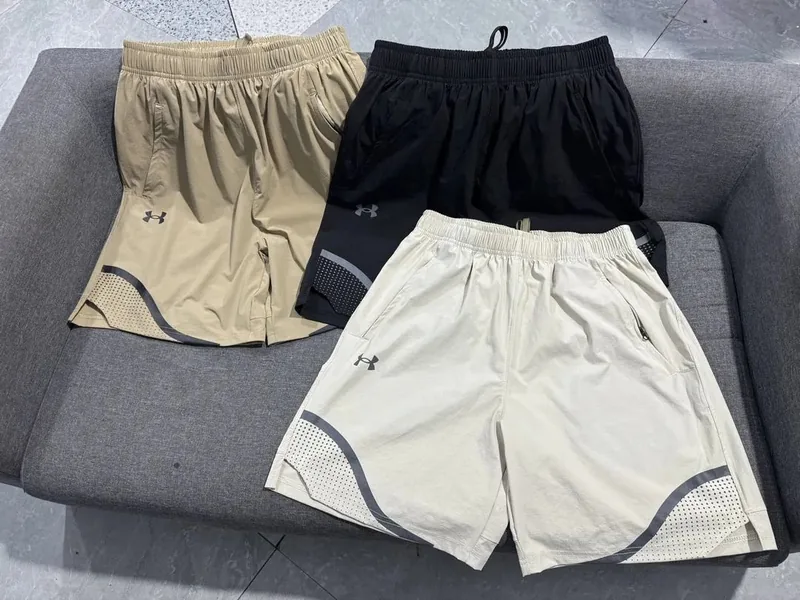
Running, training and hiking shorts are where everything you are paying for is invisible. Whether the seams are flatlocked so they do not chafe over ten kilometres, whether the waistband holds when it is wet, whether the fabric moves moisture or just feels smooth in a photo, whether the liner exists — none of it photographs. The technical shell short at $30.36 is the one pick here where a liner is actually visible in the listing image, worn on a model, and the running shorts with inner brief at the same price show the same construction on the rack. The perforated woven training shorts at $19.18, the croc-logo woven shorts at $22.37 and the lightweight nylon hiking shorts at $25.57 are the lifestyle end of this group — bought to look like sportswear rather than to be used as it, which is a perfectly good reason to buy them, and a much lower-risk one. Read the last section before you buy any of these to actually train in.
One pick sits slightly apart: the crinkle metallic nylon shorts at $24.79 carry no logo at all, in around ten colours. That makes them the blank option in a category that is otherwise all badges — the same argument we make at length in the bags guide, where a bag with no logo on it does not carry anyone's trademark. If you want the shape without the branding question, this is the pick.
Denim and cargo — the type where the photo actually tells you enough
Denim is the honest exception to this whole page. There is no hidden liner, no performance claim, and the entire product — weave, wash, stitching, hardware, pocket shape — is visible from the outside, which is the one case where a standard flat-lay QC set is genuinely sufficient. It also happens to be a fabric Chinese factories make extremely well. The carpenter denim shorts at $33.52 come in three washes; the light-wash carpenter pair at $36.05 is the single-wash version of the same idea. Against Carhartt WIP's own shorts line — Landon at $108–155, Brandon at $118–128, OG Single Knee at $138–168 and OG Double Knee at $185–198 — these are a three-to-five-times saving on a garment where you can verify almost everything before approving.
The cargo picks work the same way. The washed cargo denim at $40.30 and the black cargo with a logo tab at $44.74 sit against a Mandler Cargo Short at $168. What to check on cargos specifically: the flap pockets should be bar-tacked at the corners rather than simply stitched, because a loaded cargo pocket pulls at exactly those two points. One honest note on the badge-tab listing at $26.27 — that single listing spans both cargo and plain sweat variants across its colourways, so confirm with your agent which one you are actually getting before you pay.
Knit and printed cotton — bought entirely for the pattern
The striped knit shorts at $76.70 and the numeric-print cotton pair at $35.16 are pure design purchases, and the failure mode is different again: on a knit, judge the stripe registration — whether the colour bands line up across the side seam and stay at a consistent width around the leg — because that is a knitting-machine setup problem, not a fabric-quality one, and it is the thing a cheap copy gets visibly wrong. The brand this knit style comes from lists monogram jacquard knit shorts at €310 and jacquard diamond monogram shorts at €590 on its own site, which prices in euros rather than dollars.
The price ladder: check it before you check the stitching
Shorts have the flattest arbitrage of any category we have covered, and the reason is simple: real shorts are already cheap at the bottom of the market. Sportswear is a commodity, and the biggest brands in the world sell perfectly good shorts for under fifty dollars. Look at where the real prices actually sit:
| The real thing | Official price | Our comparable pick |
|---|---|---|
| Nike DNA Academy 8" basketball short | $37 | $19.18 – $57.53 |
| Nike Miler brief-lined running short | $42 | $30.36 |
| The North Face Simple Dome short | $50 | $25.57 |
| On Core Shorts (inner brief) | $60 | $30.36 |
| Fear of God Essentials Classic Sweatshort | $90 | $26.65 |
| Carhartt WIP OG Single Knee short | $138 – $168 | $33.52 – $44.74 |
| Denim Tears Cotton Wreath sweatshorts | $175 | $95.88 |
| BAPE Color Camo Shark sweat shorts | $289 | $15.15 |
Read that table from the bottom up and the strategy writes itself. At the top of the list the copy is unanswerable — nineteen to one on the shark camo, roughly three to one on the Essentials sweatshort, three to five to one across the Carhartt-style workwear. At the bottom of the list it collapses. A $37 Nike basketball short is cheaper than eleven of the twenty-one picks on this page. And the Denim Tears comparison is the thinnest saving we have published on any guide: $95.88 against $175 is a 45% discount, not a multiple, on a garment where you are buying a print.
That is a different shape of finding from the Stüssy page, where a real three-pack of tees turned out to be cheaper per unit than our cheapest copy. There the flip was specific to one brand's entry-level product. Here it applies to a whole category, for a structural reason: shorts are the cheapest thing the world's largest sportswear companies make, so the floor of the real market is unusually low. The practical rule: if you are buying a graphic, the copy wins easily. If you are buying a plain athletic short, look up the real price first — you may find it costs less.
When to buy the real thing instead
Buy real performance shorts. Not for safety, not for durability, and not because the craft cannot be copied — but because the specific thing you are paying for in a running or training short is exactly the part a rep factory removes, and the real version costs almost nothing.
A brief-lined Nike Miler is $42. On's Core Shorts, with an inner brief, are $60. Arc'teryx's Norvan Liner Short is $100 and its linerless sibling $90. In that segment the liner, the flatlock seams that stop you chafing at kilometre eight, and a waistband that holds when it is soaked are not decoration — they are the product, and every one of them is invisible in a QC photo. Meanwhile $42 is twelve dollars more than our technical picks and less than half of several picks further down this page. The saving is not worth the coin-flip.
This is the same line we draw elsewhere on the site for different reasons: buy real for anything with a battery or a heating element, buy real sunglasses if you need certified impact or genuine polarisation, buy a real belt if you want one that outlives the trousers. The reason here is narrower and more arithmetic: the function is the hidden part, and the real one is $42.
Everything else on this page — the graphics, the camo, the workwear silhouettes, the knits, the sweat shorts you will wear to get coffee — buy the copy without hesitating. Just ask for the three photos first.
Where to go next
New to agents? Start with the full how to use Kakobuy walkthrough, then browse everything in tops and bottoms or see the wider best Kakobuy finds across every category. Because shorts fold down to almost nothing, our shipping guide shows how to slip two or three pairs into an order you were already sending, and the QC photos guide covers the general method behind the three shorts-specific requests above. If you liked the workwear picks, the jackets guide covers the same territory in the other season.
Frequently asked questions
How much do reps shorts cost on Kakobuy?
From $15.15 for camo shark-print sweat shorts up to $95.88 for wreath-print terry shorts, with most picks landing between $20 and $40. But shorts are the one category on this site where you should check the real price before you buy the copy. A Nike DNA Academy basketball short is $37 and a brief-lined Nike Miler running short is $42 — both cheaper than several of the reps on this page. The copy only wins convincingly at the top: BAPE's Color Camo Shark Sweat Shorts are $289 against our $15.15, and Denim Tears Cotton Wreath sweatshorts are $175 against our $95.88. Read the price ladder section before you decide which half of this page you are shopping.
What is a liner and why does it matter on reps shorts?
A liner is the mesh brief sewn inside a pair of athletic shorts. It is not a bonus — it is a component that brands name and charge for. Nike puts it in the product name ("Brief-Lined" versus "Unlined"). Arc'teryx sells the Norvan Liner Short at $100 and the linerless Norvan Short at $90. On sells the Train Shorts at $65 and the Train 2-in-1 at $75. The North Face charges $70 for the Wander 2-in-1. Eric Emanuel charges $98 for the Basic Short and $128 for the Double Layer. Every one of those gaps is the liner. And the liner is exactly what a cheap factory deletes, because a flat-lay QC photo of a folded pair of shorts never shows the inside. If the liner matters to you, ask for a photo with the waistband turned inside out before you approve.
What size shorts should I order from a Chinese seller?
Order for the length, not the waist. Almost every pair on this page has an elastic waistband and a drawstring, which means the waist self-corrects across two or three sizes — same principle as a belt you can trim. What does not self-correct is the inseam and the rise, because you cannot shorten a short without cutting off the hem detail (the raw edge, the taping, the side split) that the design depends on. The trap is that Chinese size charts usually list 裤长 — total length measured from the top of the waistband — not the inseam. Total length includes the rise, so a "48cm" short is not a 48cm inseam. If the chart gives a rise as well, the inseam is roughly the difference between the two. If it gives only one number, measure a pair you already own the same way (waistband top to hem) and match that.
How can I tell if reps shorts will be see-through?
You mostly cannot, from the photos you are given, and this is the failure that catches people out because shorts are a summer garment worn in bright light. A QC photo is shot flat on a table with light coming from above, which is the one lighting condition in which nothing is ever see-through. Two things reduce the risk: prefer darker colours and heavier constructions (French terry, fleece-back jersey, twill, denim) over pale thin single-jersey, and ask the QC agent for one photo with the fabric held up against a window or a lamp. That single backlit shot answers the question in a way no flat-lay can. Mesh basketball shorts are a special case — mesh is meant to be open, so what you actually want there is the liner underneath.
Which type of reps shorts is the safest to buy?
Sweat and fleece shorts, by a distance. They have no liner to delete, no waterproofing to fake, no technical claim to fall short of, and the heavier knit hides the two cheapest failures (thin fabric and sloppy overlocking). Denim and carpenter shorts are the next safest, because denim is a commodity fabric that Chinese factories genuinely make well and the whole product is visible from the outside. The riskiest are technical performance shorts — running, training, hiking — where the things you are paying for (liner, flatlock seams that do not chafe, a waistband that stays put, fabric that actually wicks) are all invisible in a photo and all optional for the factory. That is also the category where the real product is cheapest, which is why the last section of this guide tells you to buy those for real.
What should I ask my QC agent to photograph for shorts?
Three things that a default QC set almost never includes. First, the waistband turned inside out, so you can see whether there is a liner and how the drawstring is anchored — a drawstring threaded through a channel with no bar-tack at the eyelets will pull out of one side on the first wash. Second, a tape measure laid along the inside leg and a second one from the top of the waistband to the crotch seam, which gives you the inseam and the rise, the two dimensions you cannot fix later. Third, a pocket pulled inside out, because pocket bags are where cheap makers save — shallow bags and gauze-thin lining are the reason a phone slides out when you sit down. Our full guide to reading QC photos covers the general method; these three are the shorts-specific additions.