
Best Reps Sweaters and Knitwear on Kakobuy
Every other guide on this site teaches you to look at something. Judge the stitching on a cap. Judge the buckle on a belt. Judge whether the paint crossed a seam on a Gallery Dept hoodie. Knitwear breaks that method, and it breaks it completely: the QC photo can come back a flawless match — right colour, right pattern, right ribbing, right logo — and still tell you almost nothing about what you bought. The reason is that the product is the yarn, and yarn is invisible in a photograph. A cashmere sweater and an acrylic one, knitted to the same pattern in the same colour, photograph identically. You find out which one arrived on day one when it itches, or in week three when it pills, or in month two when the elbows have grown and stayed grown. This guide ranks the knitwear worth buying on Kakobuy Drop from $18.98, and then does the thing this category actually requires: works out what you can and cannot know before you pay, what the word "cashmere" is legally obliged to mean, and the one comparison where buying the real thing wins outright on price.
Which reps sweaters and knitwear are actually worth buying?
Every piece below was confirmed live before publishing and confirmed from its own single-product photograph — which, in this category, eliminated more candidates than in any other guide we have written. We opened 58 listings and kept 22. They are grouped by knit structure rather than by brand, because structure is the one property a photograph reports honestly, and it is therefore the only thing you can shop on with confidence.
Cable and rib — structure you can count
| Pick | What the photo shows | Price |
|---|---|---|
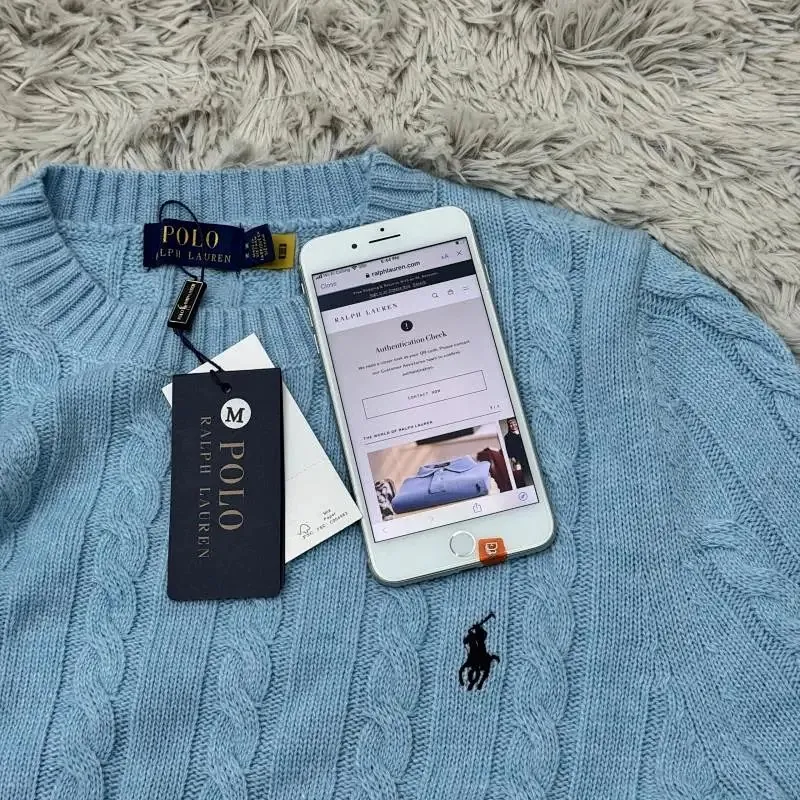
| Ralph Lauren Pony Cable Knit Sweater | Light blue, rope cable, tags in shot | $18.98 |
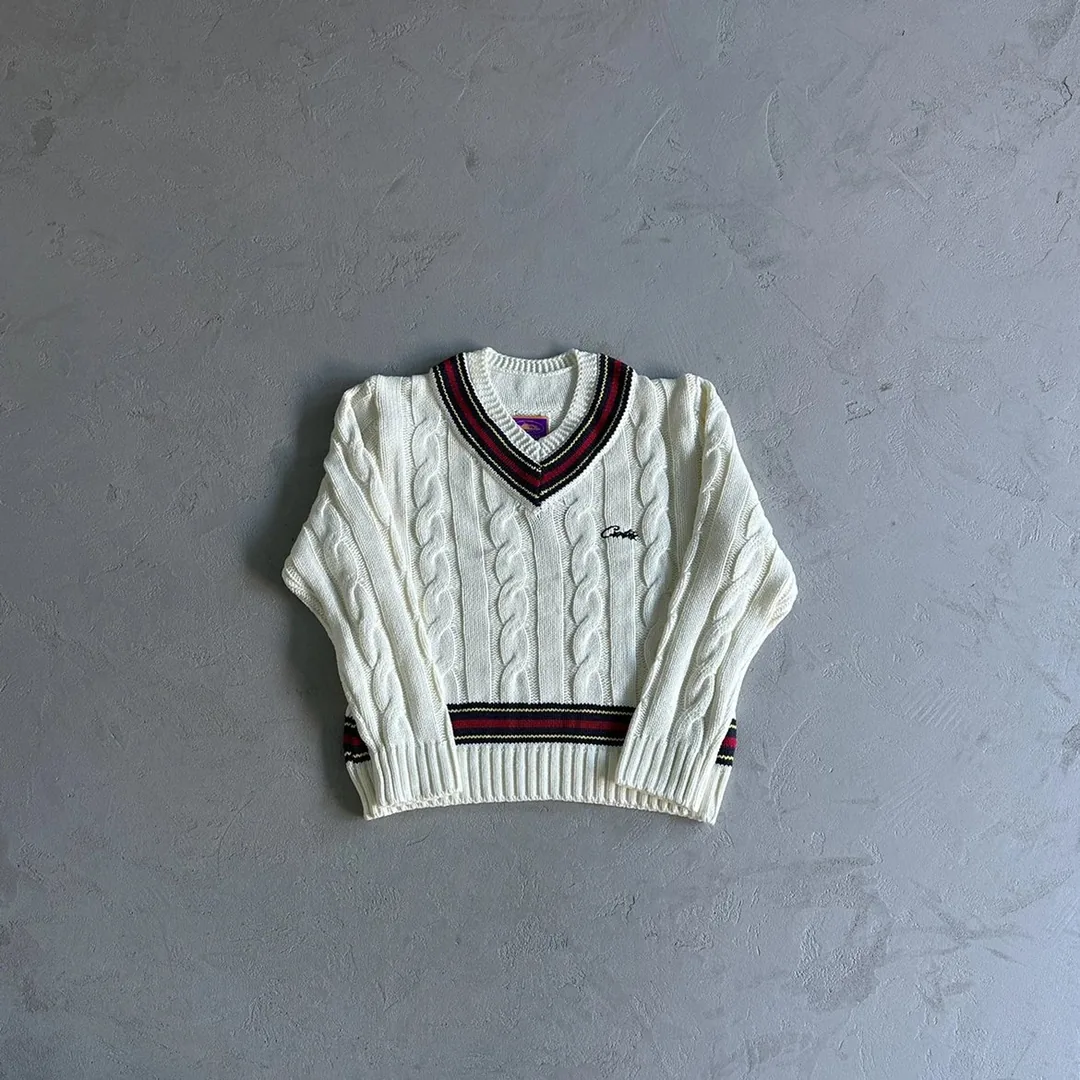
| Corteiz V-Neck Cable Knit Sweater | Cricket knit, cream with tipped V | $35.16 |
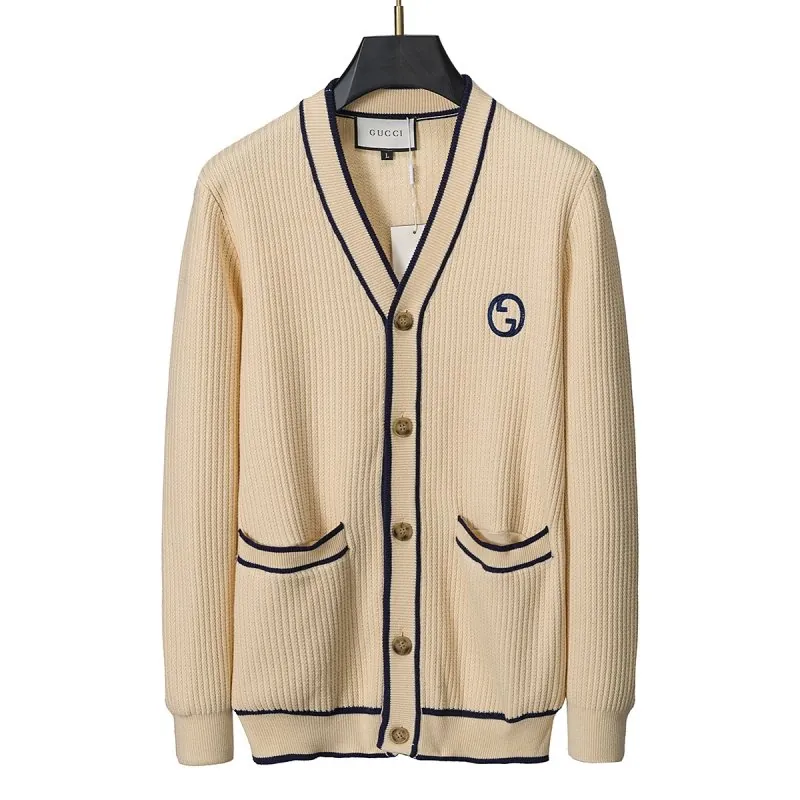
| Gucci GG Logo Knit Cardigan | Cream ribbed cardigan, navy tipping | $54.77 |
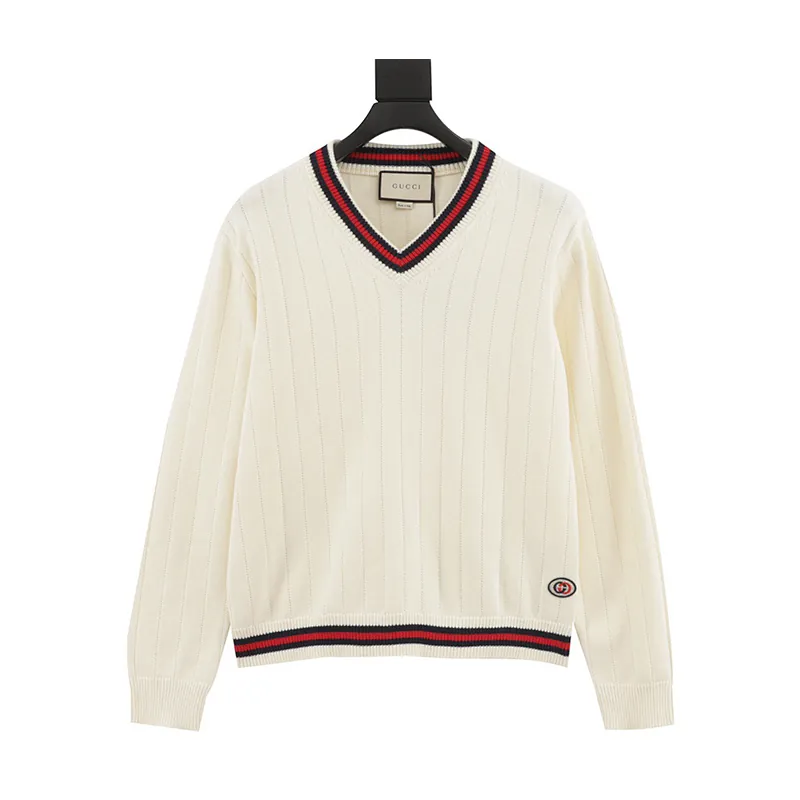
| Gucci GG Emblem V-Neck Knit Sweater | Cream, green and red web at neck and hem | $81.50 |
Mohair and brushed — the halo is visible
| Pick | What the photo shows | Price |
|---|---|---|
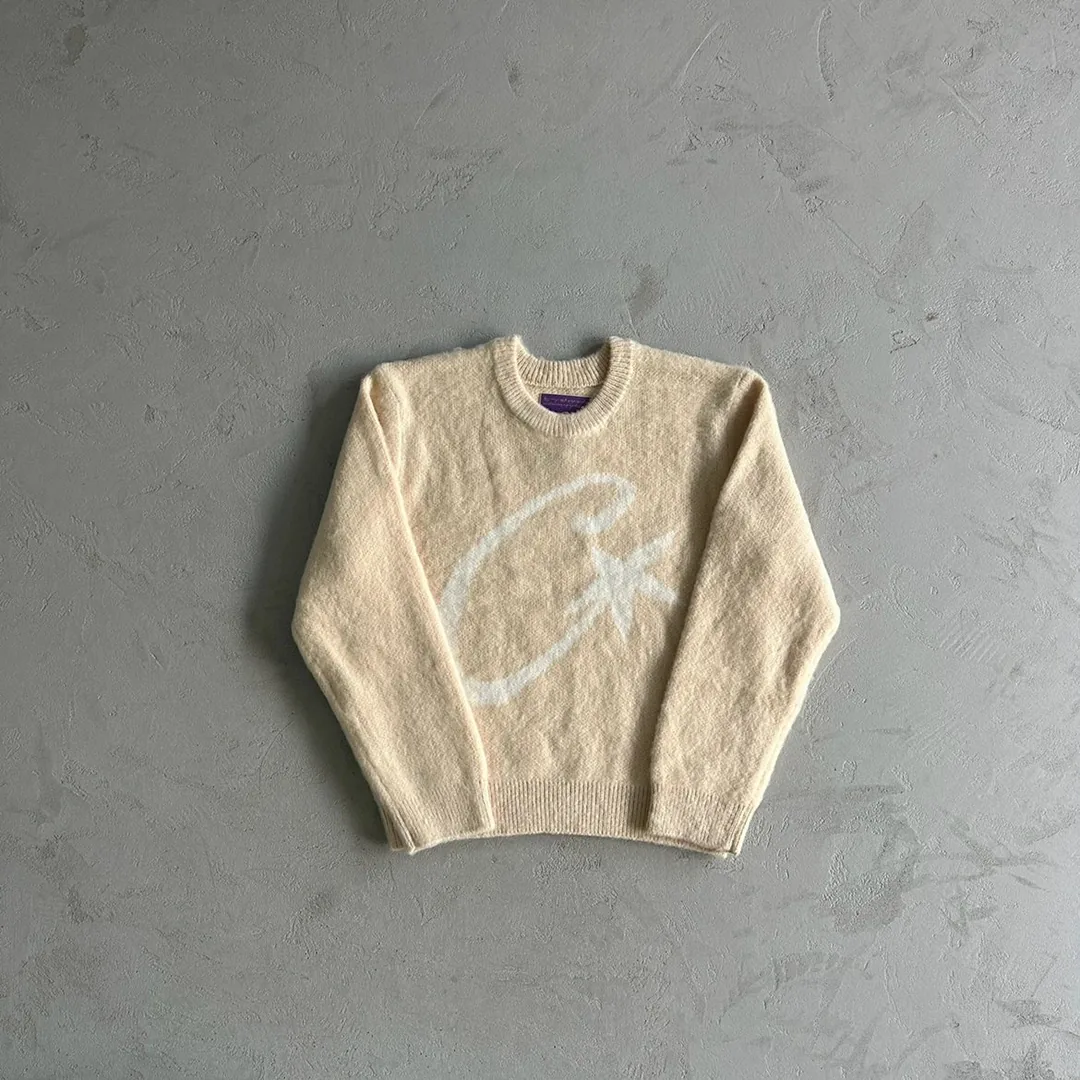
| Corteiz Big C Mohair Knit Sweater | Cream, brushed halo, tonal C-star | $29.56 |
| Corteiz Mohair Camouflage Jumper | Purple and grey camo, heavy brush | $29.56 |
| Corteiz Star Logo Mohair Knit Sweater | Black, white C-star, strong halo | $69.70 |
Waffle and textured
| Pick | What the photo shows | Price |
|---|---|---|
| Corteiz Star Logo Waffle Knit Long Sleeve | Olive, fine waffle, small chest logo | $21.57 |
| Chrome Hearts Cross Patch Knit Sweater | Grey waffle, cross patches at cuffs | $69.03 |
Fine gauge and intarsia logo knits
| Pick | What the photo shows | Price |
|---|---|---|
| Stussy Big Script Logo Knit Sweater | Black, large white script intarsia | $30.30 |
| Off-White Knit Sweater | Black, "Off." intarsia at chest | $34.80 |
| Ami Paris Pink Knit | Pink, tonal A-heart | $35.48 |
| Ralph Lauren Fine Knit Crewneck Sweater | Grey, fine gauge, small pony | $35.67 |
| Acne Multicolor Knit | Black, slim fine-gauge long sleeve | $41.55 |
| Stussy Arc Logo Cotton Knit Sweater | Black, white script, cotton claimed | $45.30 |
| Balenciaga 3B Sports Icon Knit Sweater | Navy, small chest logo | $45.64 |
| Dior For My Real Friends Knit Sweater | White, blue script embroidery | $59.83 |
| Stone Island Compass Badge Zip Knit Cardigan | Cream zip cardigan, sleeve badge | $60.98 |
| Ralph Lauren Polo Bear Knit Sweater | Navy, intarsia bear | $65.58 |
| Dior Logo Knit Sweater | Pink, tonal logo, striped cuffs | $68.85 |
| Moncler Logo Patch Knit Sweater | Navy, chest patch | $74.49 |
| Miu Miu Layered Cashmere Wool Sweater | Grey with layered collar detail | $79.74 |
Browse more tops and knitwear →
Prices are the live Kakobuy Drop prices at the time of writing and move with the catalogue. Brand names describe the piece a garment is modelled on. The "what the photo shows" column records what the listing's own single-product photograph shows, opened one at a time.
What "cashmere" is legally required to mean
Here is the part that turns out to be genuinely useful, and it needs one honest caveat up front. US fibre labelling law is a rule for sellers in the US market, enforced by the Federal Trade Commission. It is not a consumer warranty, and it does not reach a purchase you make directly from an overseas seller — the FTC's own guidance places the legal responsibility on the US importer and says explicitly that a foreign company's guarantee is not a defence. So none of what follows is a right you can enforce on an order like this.
What it is is a vocabulary. The law defines what these words are obliged to mean when someone uses them properly, which gives you a yardstick for telling a specific, testable claim apart from a vague one.
Cashmere has three numbers behind it. Under 16 CFR 300.19, the term may be used only if the fibre consists of the fine dehaired undercoat of a cashmere goat, the average diameter does not exceed 19 microns, and no more than 3 per cent by weight of the fibres have average diameters exceeding 30 microns. A coefficient of variation around the mean of up to 24 per cent is permitted. Read the first number carefully: it is the average that must come in under 19 microns, not every fibre. And the dehairing step is part of the definition rather than a marketing flourish — removing the coarse guard hair is what makes the undercoat cashmere.
The consequence is the interesting bit. Cashmere-goat fibre that fails that test is not illegal to sell. The FTC's guidance says it simply has to be labelled as wool instead. That is exactly the gap that cheap "cashmere" occupies — not fake goats, just coarser fibre from real ones, sold under a word it has not earned.
Cashmere is legally wool, which is why it has its own act. This trips up most writing on the subject. Under 15 U.S.C. 68(b) the statutory term "wool" already includes the hair of the Cashmere goat, so cashmere garments fall under the Wool Products Labeling Act and its rules at 16 CFR Part 300 — not the Textile Fiber Products Identification Act, which expressly excludes anything covered by the Wool Act. A cotton or acrylic sweater goes one way; a wool, cashmere, mohair or alpaca sweater goes the other.
A label saying "wool" rules almost nothing out. This is the most quietly useful rule in the whole body of law. Under 16 CFR 300.18 the name of a speciality fibre "may be used in lieu of the word wool" — may. Naming it is optional. So genuine alpaca can be sold, entirely lawfully, as "100% Wool". The asymmetry is what you use: a vague label tells you very little, but a specific label commits the seller. "Alpaca" is a claim about a fibre at a percentage. "Wool" is barely a claim at all.
Two more that are worth carrying around. Under 16 CFR 303.3 a fibre present at under five per cent generally cannot be named at all and must be shown as "other fiber" — so "other fiber" on a label is mandatory drafting, not evasion. Wool is the exception: 16 CFR 300.3(b) requires the wool percentage always to be stated, however small. And "pashmina" is not a fibre name in this system at all; FTC guidance states plainly that it is not a labelling term recognised by the Wool Act and rules, and that a label cannot say "100% Pashmina". If you see pashmina presented as a grade of cashmere, the page has invented it.
Misspellings are prohibited, which makes them a tell. Under 16 CFR 303.18 a fibre name that is phonetically similar to, or a misspelling of, a real generic name cannot be used — so "Kashmere" on a tag is not a typo you should read past. It is the one thing on a label that is doing deliberate work.
And the Woolmark logo is a graded claim, not a single one. Woolmark's own current specifications set three tiers: the plain Woolmark mark is pure new wool, Woolmark Blend requires at least 50 per cent new wool, and Wool Blend covers 30 to 50 per cent. Which of the three logos appears tells you roughly where in that range the garment sits, so it is worth reading the words under the mark rather than just recognising the shape.
None of that lets you audit a seller in Guangzhou. What it does is let you read a claim properly. A listing that says "cashmere blend" with no percentage has said nothing. A label photograph reading "70% Wool, 30% Nylon" has said something specific, and you can decide whether you want it.
The comparison where the real thing simply wins
We have made the buy-the-real-one argument on this site before — for Stussy, where the price ladder turned out to matter more than the stitching, and for jeans, where an ordinary pair of Levi's undercut several of our own picks. Knitwear produces the sharpest version of it yet, and it comes from putting two numbers we collected on the same day next to each other.
Corteiz publishes the fibre content of its own knitwear. On 6 August 2026 its knitwear range ran $95 to $200, with $175 the dominant price point — 18 of the 31 pieces sat there. The listed compositions at that price included:
| Authentic Corteiz piece | Stated composition | Price |
|---|---|---|
| Multi Stripe Knit Zip Up | 100% acrylic | $175 |
| VVS Panel Knit Sweater | Acrylic knit sweater | $175 |
| Turismo Knit Sweater | Cotton/acrylic blend knit | $160 |
| Alcatraz Heavy Knit Zip Hoodie | Cotton/acrylic blend knit | $200 |
| Script Pocket Knit Sweater | Wool/nylon/acrylic blend knit | $175 |
| Santi Knit Jersey | 100% cotton knit jersey | $115 |
Now the other number. On the same day, a Uniqlo crewneck labelled 100% cashmere was $99.90. Its merino crewneck was $49.90, and its lambswool crewneck the same.
Put those side by side and the ladder crosses over. The authentic streetwear sweater at $175 is acrylic. A genuine cashmere sweater costs $99.90 — forty per cent less. Whatever you are paying the $175 for, it is not the fibre, and it was never the fibre. You are paying for the logo, the drop, the fact that other people recognise it. That is a real thing to want and we are not going to pretend otherwise.
Ralph Lauren makes the same point from the other direction, and more precisely, because it sells the same cable-knit sweater in two fibres. At an authorised US retailer on 6 August 2026, the cotton cable-knit crewneck was $145 to $168 and the wool-and-cashmere cable crewneck was $228. So inside one brand, upgrading the entire fibre content from cotton to a wool-cashmere blend costs about $60 to $83. And the plain cashmere crewneck at Uniqlo, at $99.90, undercuts Ralph Lauren's cotton one. Fibre quality and price are close to uncorrelated across this market — what you are paying for, almost everywhere, is the name on the chest.
Two more data points settle it, both with the composition confirmed on the brand's own product page. An Off-White crewneck at $595 is 100% cotton. A Dior cable-knit sweater at $2,700 is 100% cashmere. Line those up against Uniqlo's $99.90 cashmere and the pattern is unmistakable: you can pay $595 for cotton or $99.90 for cashmere, and the difference between those two prices has nothing to do with what the sweater is made of.
That gives two of our picks unusually clean anchors. The Polo Bear knit at $65.58 sits against a Polo Bear cotton crewneck at $398 — about six times. The Pony cable knit at $18.98 sits against the cotton cable-knit crewneck at $145 — about 7.6 times. Both official garments are cotton, which is worth holding on to: the thing being replicated at those prices is not a luxury fibre either.
So the honest framing of this category splits cleanly in two:
- If you want the logo, the replica is doing exactly the job the original does, because the original's material is not the point either. Our $29.56 mohair-look Corteiz against their $175 acrylic is a comparison between two synthetic sweaters, and the multiple is about six.
- If you want a good plain sweater — warm, soft, holds its shape, lasts — the replica market is the wrong shop, and so is Corteiz. $99.90 buys cashmere with a legally-defined meaning behind the word, and $49.90 buys merino. Neither of those is a number the replica shelf can beat on value, because the replica shelf is not selling fibre quality at all. It is selling the appearance of a brand.
One precision note on our own listings, because it matters for the mohair picks above. Three of them have "mohair" in the title. None of the 31 knitwear pieces Corteiz had on sale the day we checked was mohair — the range was cotton, acrylic and wool blends. That does not make our listings wrong; brands run different yarns in different seasons, and a brushed halo is clearly visible in all three photographs. It does mean the word in the title is not traceable to anything, and should be read as a description of the look rather than a claim about the fibre.
What a photograph can and cannot prove
This is the practical core, and it is shorter than you would hope.
Three things a photograph reports honestly. The first is knit structure. Cable, rib, waffle, crochet, jacquard and intarsia are geometry, and geometry cannot be faked by a flattering camera — a cable either has the rope crossings or it does not, a waffle either has the raised grid or it does not. That is why the picks above are grouped by structure: it is the one column where the photo is evidence. The second is the halo on a brushed or mohair-type yarn, which shows as a visible fuzz standing off the surface against a plain background, as it does in all three Corteiz mohair shots. The third is the inner label — but only if you ask for that shot specifically, because it is not part of a standard QC set.
Everything that actually determines whether you like the sweater in a month is invisible. Fibre content. Yarn ply. Staple length. Twist. Those four decide whether it pills, whether it itches, whether it grows out of shape, and whether it survives washing — and not one of them can be read off an image at any resolution. This is the structural difference between knitwear and every other category on this site. A belt buckle either looks right or it does not. A pair of jeans can be measured with a tape before it ships. A sweater passes every visual check and then fails you slowly, after the return window, in a way no photograph could have predicted.
So make one specific request. Ask your agent for a close, in-focus photograph of the inner care and content label, and ask before you pay rather than after the parcel is in the warehouse. Three outcomes, all of them informative:
- There is a label with a composition on it. Now you have a claim you can evaluate. Percentages that add to 100, a named fibre rather than a vague one, a country of origin. It is still only a claim — nothing verifies it — but a specific claim is a much better basis for a decision than silence.
- There is a label with no composition, or a brand tag only. That is common and it tells you the garment was not made to be sold into a market that requires the disclosure. Price it accordingly.
- There is no label at all. Also an answer, and arguably the clearest one.
Our QC photos guide covers how to request additional shots and what a normal set includes. The label shot is the single highest-value extra request in this category, and it costs nothing to ask.
Read the title before you read the photograph
One catalogue-specific habit will save you more grief than anything else here, and we found it by accident while picking the 22 items above.
We opened 58 candidate listings for this guide. Ten of them had the word "Collection" in the title. All ten turned out to be a supplier's catalogue grid — nine or twelve different sweaters in one image, or a rack of colourways on hangers — rather than a photograph of a single garment. Not one was a product shot. Across the whole knitwear shelf, 93 of the 562 listings carry that word, about one in six; catalogue-wide it is 2,836 listings out of 28,028.
The practical rule: if a knitwear title ends in "Collection", you cannot tell from the page which garment you would receive. The listing may be perfectly legitimate — the seller has one item and used a catalogue image for it — but you have no way to know which one, and the colour you are looking at may not be the colour that ships. Message the seller for a single-product photograph before ordering, or pick a listing that already has one. Every pick in this guide has one.
The same pass turned up the usual crop of feed errors, and knitwear has a particular flavour of them worth naming. Of the 58 listings we opened, five were not knitwear at all: a listing titled Casablanca Knit pictured a pair of knit shorts, Arc'teryx Multicolor Knit and North Face Multicolor Knit both pictured stacks of technical shell jackets, and Kenzo Multicolor Knit pictured two short-sleeve piqué polo shirts. The sharpest of them: the most expensive garment in the entire knitwear shelf, listed at $504.97 as "Ralph Lauren Knit Women", is a suede western jacket with horse embroidery. There is no knitting anywhere in the photograph. One further listing titled Amiri Embroidered Crewneck Wool Sweater pictures three Ami Paris sweaters with the red heart logo — a different brand entirely, and the only listing in the batch to claim "wool" in a title while also having the brand wrong.
Four more were rejected for a different reason: their photographs carry another seller's watermark and contact details — one has a WeChat ID, a Discord handle and a phone number printed across the garment, another two are stamped with a messaging handle, and a fourth is a promotional graphic with a "MAX Sale" banner and a QR code where the product shot should be. Those are supplier marketing images that ended up in the feed. We have excluded them here, and they are being cleaned up.
Adding it up: of 58 knitwear listings opened one at a time, 22 were usable. The rest were catalogue grids, colourway racks, wrong categories, wrong brands, watermarked supplier art or one entirely out-of-focus image. Thirty-eight per cent usable is the worst rate we have recorded — for comparison, the denim audit rejected 28 per cent of what it opened, and this one rejected 62 per cent. It is also the reason this guide is 22 items rather than 40.
When to buy the real one
Three cases, and the first is broader than on any other page we have written.
If you want a plain sweater, buy a plain sweater. This is the honest headline and it is not close. A cashmere crewneck with a legally defined meaning behind the word is $99.90 at Uniqlo, merino is $49.90, and lambswool is $49.90. Nothing on the replica shelf competes with that on value, because the replica shelf is not selling you fibre — it is selling you a logo, and a plain sweater has no logo to sell. If your want is "something warm and soft in navy", the answer is not on this page.
If the sweater needs to survive real wear over years. Fibre content, ply and twist decide longevity, none of them are disclosed here, and none of them are visible in a QC photo — so buying for durability is buying blind. That is a bad trade at any multiple. Where the official price ladder is closest to reachable, buy into it: Lacoste's cotton crewnecks were $98 to $150 and its merino crewnecks $150 to $170 on 6 August 2026, which is real money but not luxury money.
If you want a specific fibre for a specific reason. Someone who wants alpaca because alpaca behaves in a particular way needs a garment whose label commits to alpaca. Our shelf has one listing in 562 that names cashmere, none that name alpaca, and no composition data at all. AMI Paris sells an alpaca crewneck at $690 and a wool one at $440; those are enormous multiples against our $35.48, but they are the prices of a garment where the fibre is a stated fact rather than an inference.
Outside those three, the case for the replica is straightforward and it rests on a narrower claim than usual. Logo knitwear is an appearance product, and the originals largely agree. When the authentic $175 sweater is 100% acrylic, the honest comparison is not "real fibre versus fake fibre" — it is two synthetic sweaters, one of which costs six times the other and comes with the recognition attached. If the recognition is what you are buying, this shelf serves it at $18.98 to $81.50, and the structural picks above — the cables, the waffles, the mohair-look brushed knits — are the ones where the photograph you are shown is actually evidence of what you will get. Just do not let the word on the label do work the label has not earned, and ask for the label shot before you pay.
Frequently asked questions
How much do reps sweaters and knitwear cost on Kakobuy?
The knitwear picks in this guide run from $18.98 to $81.50, and the wider shelf goes higher. That is a much wider spread than most categories on this site — kids football kits are all $14.06, for instance — because knitwear covers everything from a plain fine-gauge crewneck to a heavy brushed mohair sweater. For comparison, on 6 August 2026 an authentic Corteiz knit sweater was $175, a Polo Ralph Lauren cotton cable-knit crewneck was $145 to $168, a Lacoste merino wool crewneck was $160, Stone Island knitwear at an authorised US retailer ran $469 to $949, AMI Paris wool crewnecks were $440 to $550, and Gucci men's knitwear started at $1,400.
How do I tell what a reps sweater is actually made of?
Usually you cannot, and it is worth being blunt about that. We checked all 562 knitwear listings in this catalogue: only 17 of them — three per cent — name any fibre at all in the title, and exactly one says cashmere. There is no material or composition field anywhere in the product data, so there is nothing behind the title to look up either. A photograph will not close the gap, because two sweaters of identical colour, pattern and stitch can be cashmere and acrylic respectively and photograph the same. The one thing you can do is ask your agent for a close photograph of the inner care and content label before the parcel ships, and treat the absence of one as an answer in itself.
What does "cashmere" legally have to mean?
In the US it has a precise, numeric definition, and it is a useful yardstick even when you are buying from outside that system. Under 16 CFR 300.19 the term cashmere may be used only if the fibre is the fine dehaired undercoat of a cashmere goat, the average fibre diameter does not exceed 19 microns, and no more than three per cent by weight of the fibres have average diameters over 30 microns. Note it is the average that must be under 19 microns, not every fibre. Cashmere-goat fibre that misses that test is not contraband — the FTC's own guidance says it simply has to be labelled as wool instead. That is precisely the gap cheap "cashmere" lives in.
Does a label saying "wool" mean sheep's wool?
No, and this surprises people. Under the US Wool Products Labeling Act the statutory term wool covers the fleece of the sheep or lamb and the hair of the Angora goat and Cashmere goat, and may include camel, alpaca, llama and vicuña. And under 16 CFR 300.18 naming the speciality fibre is optional — the rule says the speciality name "may be used in lieu of the word wool". So genuine alpaca can lawfully be sold as "100% Wool". The asymmetry is the useful part: a vague label rules nothing out, but a specific one commits the seller. If a label says alpaca, it is claiming alpaca at that percentage; if it says wool, you have learned very little.
Is a replica sweater worse value than a real one?
For logo knitwear, no. For plain knitwear, often yes — and this is the one category where the arithmetic genuinely reverses. Corteiz publishes its own compositions, and on 6 August 2026 its knitwear ran $95 to $200 with the main price point at $175, where the listed content included "100% ACRYLIC", "ACRYLIC KNIT SWEATER" and various cotton/acrylic blends. On the same day a Uniqlo crewneck labelled 100% cashmere was $99.90 and its merino crewneck was $49.90. So the authentic streetwear sweater at $175 is acrylic, and a genuine cashmere sweater costs less than it. If what you want is a warm, soft, well-made plain sweater, the replica market is not where the value is — the value is at Uniqlo, and it is not close.
What can a QC photo actually prove about knitwear?
Three things, and it is worth knowing which three. It can show you knit structure — cable, rib, waffle, crochet and jacquard are geometry, and geometry photographs honestly. It can show you the halo on a brushed or mohair-type yarn, which is visible as a fuzz standing off the surface. And it can show you the inner label, if you ask for that shot specifically. What it cannot show is fibre content, yarn ply, staple length or twist, which between them determine whether the sweater pills in three weeks, itches on day one or sags out of shape by the second wearing. Our QC photos guide covers how to request extra shots.
Why do so many listings show a grid of different sweaters?
Because the photograph is the supplier's catalogue page rather than the product. It is common enough here to be predictable: 93 of the 562 knitwear listings — one in six — have the word "Collection" in the title, and every one of the ten we opened turned out to be a multi-garment grid or a rack of colourways rather than a single item. Treat "Collection" in a title as a warning that you cannot tell which garment you are buying, and message the seller for a single-product photograph before ordering. The picks in this guide were all confirmed from their own single-product photograph for exactly this reason.