
Best Reps Puffers and Down Jackets on Kakobuy
Every category on this site sells you a look. A down jacket sells you a number. Two of them, in fact — how lofty the down is, and how many grams of it are in there — and multiplied together they are the entire product, because they are what makes the jacket warm. Here is the problem. We searched all 28,028 listings in this catalogue for any statement of fill power, fill weight, down content, temperature rating or Responsible Down Standard certification. The answer was zero on all five. Not "rarely stated" — never stated. And unlike stitching on a cap or paint on a hoodie, none of it can be recovered from a photograph, because the product is sealed inside the shell. This guide ranks the puffers and down jackets worth buying on Kakobuy Drop from $28.76, and then does the thing this category genuinely requires: works out what you can know before you pay, what you cannot, and the one specification that is hiding in plain sight in every photograph you have already been sent.
Which reps puffers and down jackets are worth buying?
Every piece below was confirmed live before publishing and confirmed from its own single-product photograph. They are grouped by construction rather than by brand, because construction is the one property a photograph reports honestly — and, as the section below explains, it is therefore the only thing in this category you can actually shop on.
Expedition parkas — smooth shell, insulation hidden inside
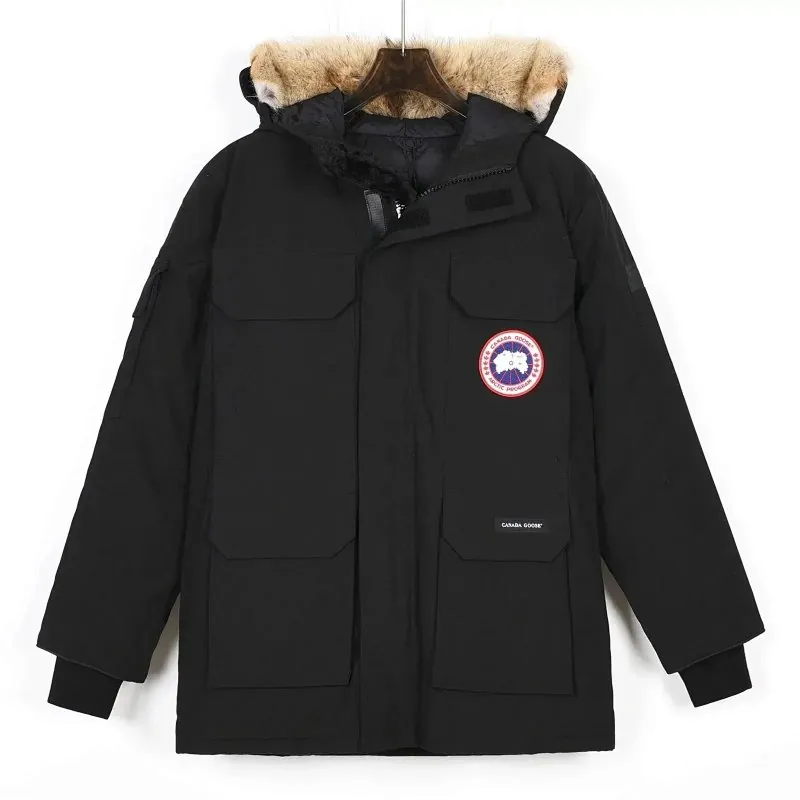
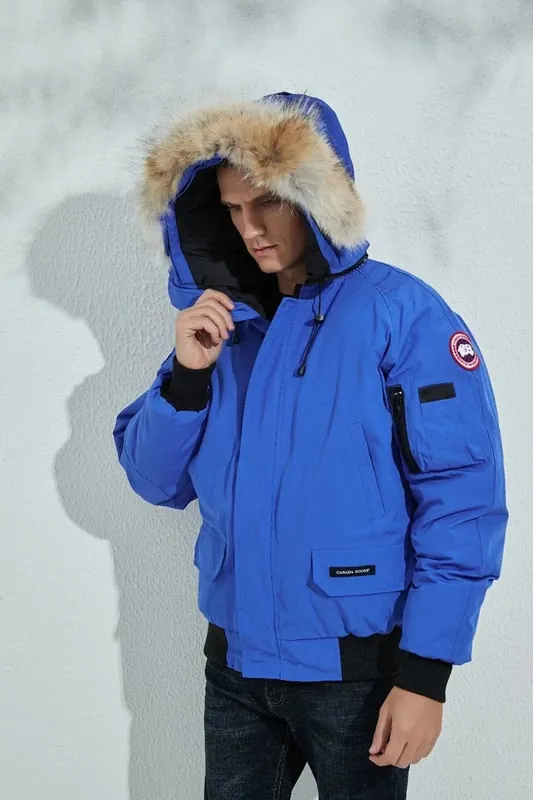
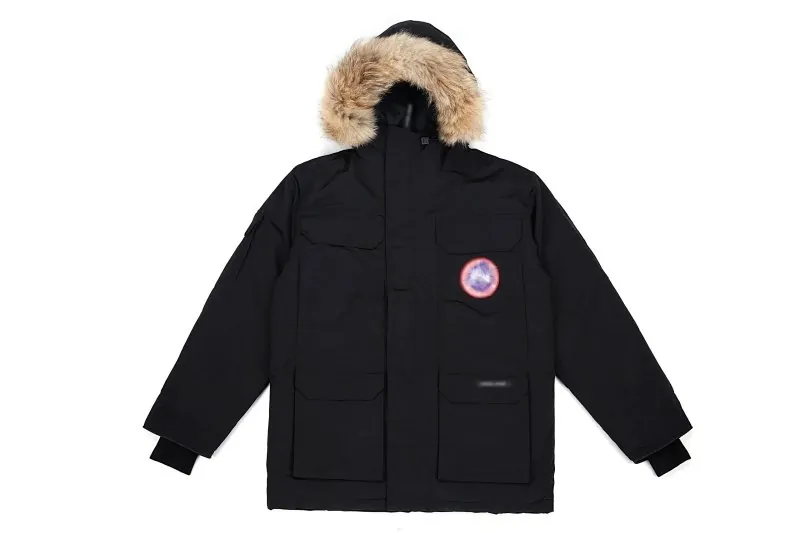
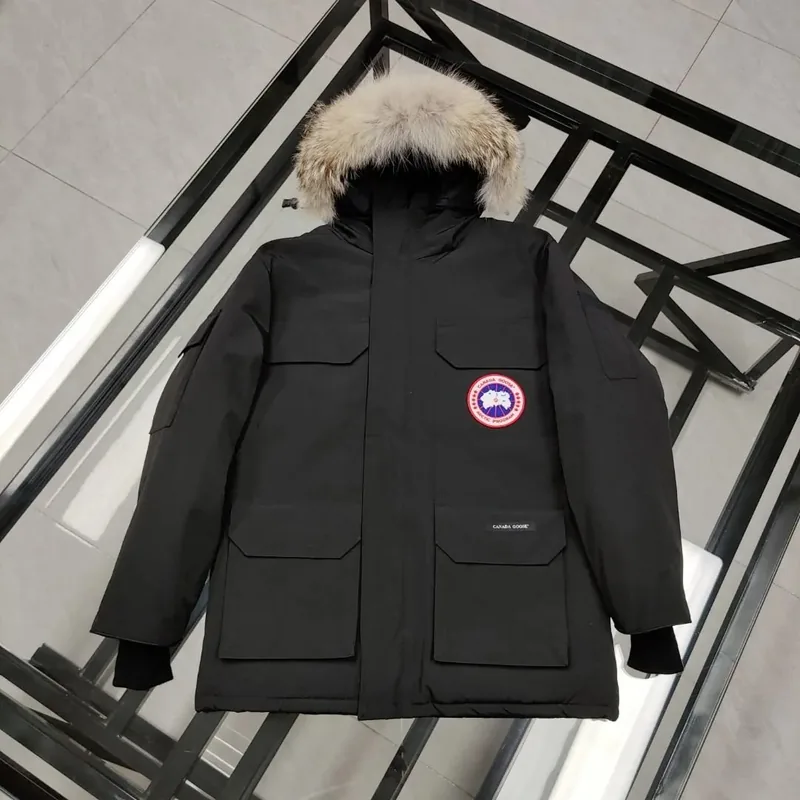
Long, hooded, fur-trimmed, and deliberately without visible quilting: the baffles on this silhouette sit inside the shell where you cannot see them. That is authentic to how the originals are built, and it also means the photograph tells you even less than usual.
| Pick | What the photo shows | Price |
|---|---|---|
| Canada Goose Hooded Down Parka | Black, smooth shell, chest badge, on hanger | $28.76 |
| Canada Goose Fur Hood Down Parka | Blue, ruffed hood up, worn on model | $45.83 |
| Canada Goose Fur Hood Expedition Parka | Black, full expedition cut, flat lay | $57.34 |
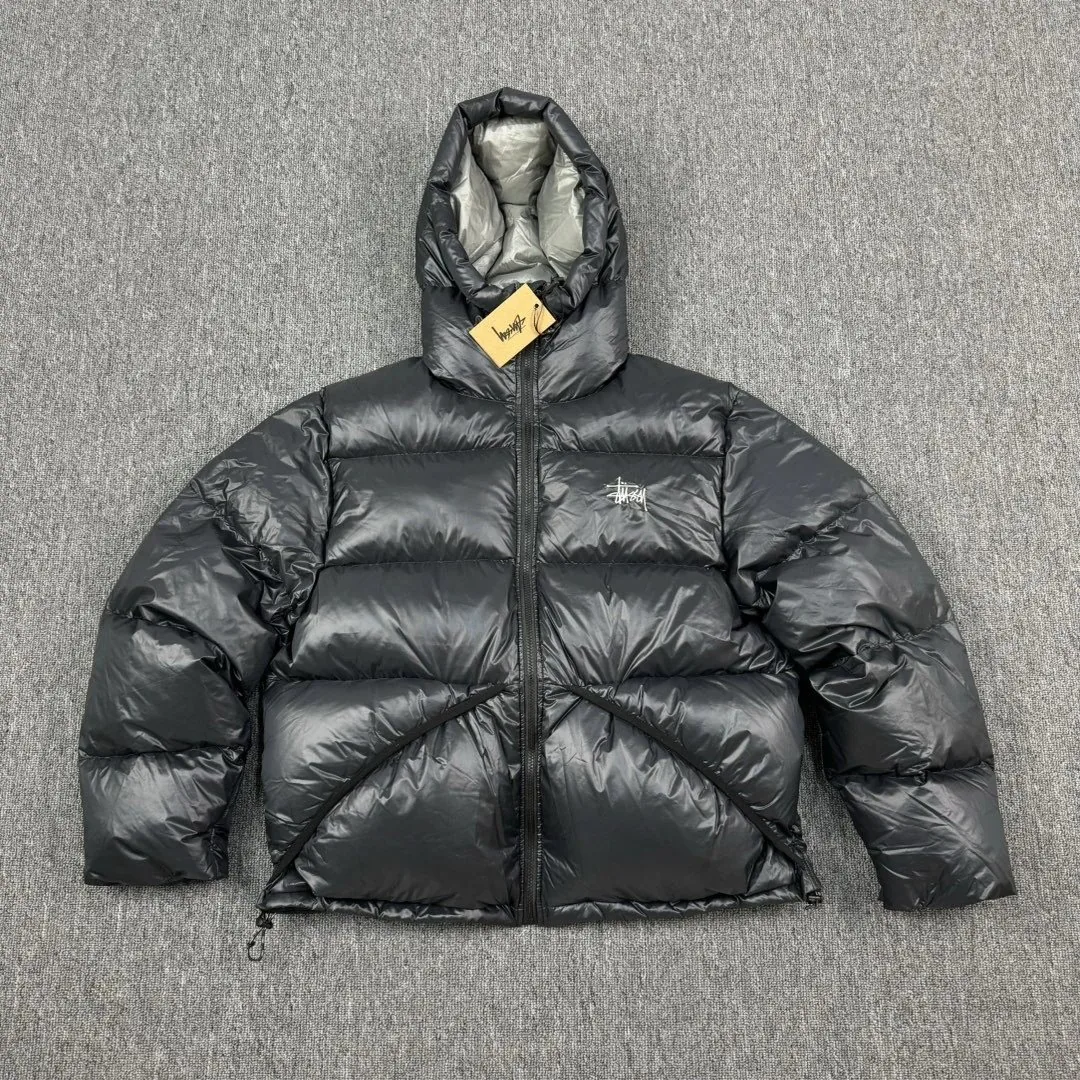
| Stüssy Micro Ripstop Down Parka | Charcoal ripstop, radial chest baffling, hood | $95.72 |
| Canada Goose Hooded Parka | Black with ruffed hood, shot in-store | $153.41 |
Channel-baffle puffers — the Nuptse silhouette
Horizontal stitched channels, high collar, short body. This is the most copied down shape in the world and the most legible in a photograph, because the chambers are right there on the outside to be counted.
| Pick | What the photo shows | Price |
|---|---|---|
| The North Face 1996-Style Nuptse Puffer | Tan body, black yoke, cuff embroidery, flat lay | $63.92 |
| The North Face Hooded Down Jacket | Off-white, hood, swing tags still attached | $83.10 |
| The North Face Printed Down Jacket | Snow-camo print, worn on model outdoors | $127.84 |
| Canada Goose Hooded Puffer (Women's) | Pale grey, arm badge, garment bag in shot | $313.21 |
Streetwear puffers — bought for the shape, not the mountain
These are worn between a car and a bar, and the honest thing to say is that the specification problem below matters far less here. Nobody is asking a logo puffer to survive an Arctic night.
| Pick | What the photo shows | Price |
|---|---|---|
| Essentials Padded Puffer Jacket | Rack of colourways, matte shell, rubber logo | $42.51 |
| Carhartt Reversible Sherpa Puffer | Both faces shown, olive and cream | $43.72 |
| Stüssy Script Logo Puffer Jacket | Black, hooded, script logo at chest | $46.60 |
| Carhartt Hooded Down Jacket | Cream and brown pair, tags in shot | $69.67 |
| Stüssy Down Jacket | Three colourways laid out together | $96.65 |
| Trapstar Hooded Down Puffer | Black, vertical logo tape, flat lay | $101.47 |
| Stüssy Down Jacket (Glossy) | Silver-grey high-shine shell, hooded | $114.86 |
Down vests — the cheapest way into the category
No sleeves means less fill, less freight and less risk. If you are testing whether this category works for you at all, a vest is the sensible first order.
| Pick | What the photo shows | Price |
|---|---|---|
| Corteiz Onion Quilted Vest | Black, circular onion quilting, flat lay | $34.52 |
| Stüssy Down Puffer Vest | Three colours in a row, stand collar | $43.43 |
| Trapstar Logo Down Puffer Vest | Black, chest logo tape, flat lay | $52.61 |
| Moncler-Style Down Vest | White, arm badge, on hanger | $63.76 |
The number that isn't there
Start with the finding, because it frames everything else. We ran five separate searches across every one of the 28,028 listings in this catalogue, looking for any of the specifications that describe insulation: a fill power figure, a fill weight in grams, a down-to-feather percentage, a temperature rating, or an RDS claim. Every one of the five returned zero results. There is also no material or composition field anywhere in the underlying product data, so there is nothing behind the title to look up either.
This is not the same problem as the one in our knitwear guide, where three per cent of titles named a fibre. Three per cent is a bad hit rate. Zero out of five categories of claim, across twenty-eight thousand items, is a different kind of statement: the vocabulary for describing this product does not exist in this marketplace at all.
There is exactly one place we found down described in any way. It was a printed swing tag hanging from the zip of the off-white hooded jacket above, and we had to enlarge the photograph to read it. It says "SUPER PREMIUM GOOSE DOWN", above a circular emblem and a line of smaller text that does not resolve at the resolution the listing provides. And that phrase is a fair summary of the whole category: "super premium" has no definition, no test behind it and no number. Fill power is a measurement. "Super premium" is an adjective printed on card.
The same jacket makes the point twice over. The tan Nuptse-style puffer in the table above carries a small three-character embroidery on the cuff, in exactly the position where the original prints its fill-power rating. At the resolution of the photograph you are given, it cannot be read. The only number on the garment is one the listing's own photography cannot show you.
What fill power actually measures — and why it is not warmth
Fill power is a loft measurement. One ounce of down, roughly 30 grams, goes into a cylinder under controlled temperature and humidity, is allowed to expand, and the volume it takes up is read in cubic inches. A rating of 700 means that ounce expanded to fill 700 cubic inches. Higher numbers mean the down traps more air per gram.
What follows from that is the single most misunderstood thing about buying down, so it is worth stating flatly:
Total warmth is fill power multiplied by fill weight. A 900-fill-power jacket holding 30 grams of down will not be as warm as a 450-fill-power jacket holding 100 grams. High fill power buys you the same warmth at lower weight and better compressibility — which is why it commands a premium in mountaineering gear where every gram is carried on your back. It does not by itself buy warmth. For scale: a typical lightweight down jacket carries around three ounces of fill, a midweight one five or six, and a serious winter parka considerably more.
Two further cautions before anyone quotes a number at you. First, fill power is not internationally comparable: the IDFB/US method, the European EN method and the Chinese GB/T method condition the sample differently, and the same batch of down can test differently under each. A number without a method attached is not a specification. Second, goose down averages higher fill power than duck down because geese are larger and more mature at slaughter — but low-grade goose down and high-grade duck down both exist, so the bird alone settles nothing either.
Since none of these figures appears in any listing here, the practical instruction is simple and slightly bleak: do not shop this category on specification, because there is no specification. Shop it on cut, on construction, and on what you actually intend to do while wearing it.
The one specification you can see
Here is the useful part, and it is genuinely actionable. There is one construction detail that determines a real amount of a down jacket's warmth, that costs meaningful money to do properly, and that is fully visible in a flat-lay photograph you have already been sent.
Sewn-through construction stitches the outer shell directly to the inner lining. It is cheaper, lighter and faster to make. The cost is that every seam pinches the down flat, so each stitch line is a thin cold strip running across the jacket — a thermal bridge. In a photograph, sewn-through chambers read as a row of ovals joined at their narrow ends, with the shell visibly drawn tight along each seam.
Box-wall construction adds a third strip of fabric — a vertical wall — between shell and lining, creating squared chambers. The down lofts to its full depth across the whole chamber and there is no stitched-through cold line. It uses more fabric, more labour and more time, and it is the standard on expedition-weight parkas for exactly that reason. In a photograph, box-wall chambers read as squares sitting side by side, with the shell staying full right up to the seam.
The reason this matters for replicas specifically: box-wall is the expensive way to build a jacket, so it is one of the first things a copy quietly drops while keeping the outline and the logo identical. A jacket sold on the silhouette of a serious expedition parka, built sewn-through, has told you something real about itself — and it has told you in a photograph, before you paid, without you having to ask the seller anything.
If you want more shots than the listing provides, our QC photos guide covers how to request them. For this category the request worth making is a close, well-lit shot of a seam.
What "down" is legally allowed to mean
You will find it stated all over the internet that the FTC requires a product labelled "down" to contain 75 per cent down cluster. That figure is a garbled memory of a rule that no longer exists, and the real history is more interesting.
The FTC did publish Guides for the Feather and Down Products Industry at 16 CFR Part 253. It rescinded the entire part effective 20 August 1998; the Federal Register notice ends with the line "PART 253—[REMOVED]". While the Guides were in force, section 253.6(f) permitted the unqualified word "down" to describe a fill mixture that was 80 per cent "down portion" — of which the down-and-plumules content only had to be 70 per cent minimum — plus a 20 per cent remainder of down fibre, waterfowl feather and small allowances for other material. The Commission's own words: this "created, in effect, a 30 percent tolerance".
The rescission notice then records something the industry had done with that tolerance. Filling material sitting right at the edge of it — that is, containing 30 per cent less down than the label stated — had acquired a nickname among manufacturers: "FTC down". A margin intended to absorb the imprecision of processing had become a production target. That was the first of the Commission's stated reasons for scrapping the Guides. Among the others: that a producer with 85 per cent down content had no way to distinguish itself, since a 70 per cent product could simply be called "down" while an honest percentage claim looked inferior by comparison; and that a 30 per cent tolerance was indefensible next to the 3 per cent allowed for blended fibre claims under the Textile Fiber Products Identification Act.
What governs now is the general deception standard in Section 5 of the FTC Act. The Commission stated at the time that modern production should support "down" labelling above 70 per cent content, and that percentage claims should be achievable to within 2 to 5 per cent rather than 30. Two honest qualifications: this is US labelling law, which does not travel with a parcel from China; and none of it is legal advice, nor a claim that any particular product breaks any rule. It is context — and the context is that even in the regulated original market, the word "down" on a label has carried a great deal less information than buyers assume. On a listing that states nothing at all, it carries none.
What RDS certification does and does not tell you
The Responsible Down Standard comes up constantly in this category, and it is routinely cited as evidence of quality. It is not evidence of quality. RDS is an animal-welfare and traceability standard: it addresses live-plucking and force-feeding and follows the down back through the supply chain to the farm. It certifies nothing whatsoever about fill power, fill weight, cluster content, warmth or durability.
A thinly filled jacket using low-loft down can be fully RDS-certified, because that is not the question RDS asks. It is a real standard doing real work on the thing it was built for — and it is no evidence at all for the thing people usually invoke it to prove. On a replica the point is largely academic anyway: an RDS claim is a supply-chain audit, and there is no audit trail here to inspect.
What we found when we opened 27 listings
The picks above are what survived. We opened 27 candidate listings and kept 20, and the failures follow the same pattern we have documented in every recent guide — the errors cluster in the automatically populated fields.
- One listing was not a down jacket at all. A $63.28 item titled "Carhartt Multicolor Down Jacket" turned out to be a photograph of four Detroit-style canvas work jackets with corduroy collars. No insulation, no quilting, wrong garment entirely.
- One was a supplier catalogue page. A $65.12 "Moncler Down Jacket" is a nine-panel grid of nine different jackets, so there is no way to know which one you would receive.
- Two were not product photographs. One is a street photograph of a crowd; another shows a person in a car holding something still wrapped in plastic.
- Two listings share one photograph. Two separately priced Essentials puffers, $42.51 and $51.01, use the same rack shot.
- Colour words in titles are unreliable. The "White Down Jacket" in our table is tan; a "Multicolor Down Jacket" is plain black. As in our denim guide, colour is one of the auto-filled fields and one of the least trustworthy.
That is roughly a quarter of what we opened, which is consistent with what we have found every time we have audited this catalogue. The general heuristic still holds and is worth repeating: a listing whose photograph shows one garment, well lit, with its tags, is a listing someone actually looked at. A grid, a rack or a crowd is not.
This is the most expensive bet on the site
Worth being explicit about, because it changes how much care is warranted. The median puffer listing here is $95.59. That is the second-highest median of any category on this site, behind watches at $114.86 and ahead of sneakers at $63.92, hoodies at $35.85, tees at $24.74 and football shirts at $18.98.
So the usual reasoning about this market — that the downside is capped at the price of a tee — does not hold here. A puffer order is a three-figure decision made on the least information available anywhere in the catalogue. That combination is why this guide spends more space on what you cannot know than on the picks themselves.
The composition of the shelf is worth knowing too, because it is not what the category's reputation suggests. Of 516 down and padded listings, 147 are Canada Goose and 72 are The North Face — 42 per cent of the shelf between two technical outdoor brands — while Moncler accounts for just 16. This is overwhelmingly a shelf of expedition-styled gear, not fashion down. That matters, because a fashion puffer that is merely adequate is still doing its job, while an expedition parka that is merely adequate is not the product it is imitating.
When to buy the real thing
This site normally argues the other way, so take the exceptions seriously.
If the jacket has to work. Real cold, long exposure, no indoors to retreat to. What you are buying in that situation is a measured quantity of insulation, and that quantity is exactly what nobody in this market will quantify. The North Face 1996 Retro Nuptse was $380 at Nordstrom on 7 August 2026 with a stated 700-fill-power goose down; a Canada Goose Expedition Parka runs roughly $1,575 to $1,895 depending on version, with 625 fill power white duck down and the brand's own top warmth rating. Those numbers are the product. Ours are $63.92 and $57.34, and they are the look.
If it is going to get wet. Down clusters absorb water and lose most of their insulating value when soaked, and a DWR finish handles light rain but not sustained wet. Synthetic insulation keeps insulating when wet — that is its one clear advantage over down. In genuinely wet conditions, buy a synthetic jacket outright rather than a replica down one; you would be paying for the wrong technology either way.
If you need a working membrane. A waterproof-breathable shell with taped seams is a fabrication problem, not a styling one, and the failure mode does not show up until weather does. Our general jackets guide covers the shell-and-hardshell side of the category.
Outside those three, the arithmetic is fine. A puffer worn from a car to an office is a shape, a colour and a logo, and all three photograph honestly.
One practical note on shipping
Down is the bulkiest thing you can buy here. Puffers are light but they take up volume, and freight is charged on whichever is greater of actual weight and volumetric weight — so a single parka can be priced as though it were several kilos. Compressing the parcel is standard practice and worth asking your agent about explicitly, and it is one order where combining several small items into the same box costs you very little extra. Our shipping guide covers how volumetric weight is calculated and which lines handle bulky parcels best.
Ready to order?
Start with a vest at $34.52 if you are testing the category, or the tan Nuptse-style puffer at $63.92 if you want the shape everyone recognises. Before you pay, do the one check that is free: enlarge the flat-lay and look at whether the chambers are ovals pinched at every seam or squares that stay full to the edge. It is the only specification in this category that will answer you honestly.
Related reading: the shell-and-hardshell side in best reps jackets, the same invisible-material problem in sweaters and knitwear, how to request extra photographs in QC photos explained, and more of the shelf in best Kakobuy finds.
Frequently asked questions
How much do reps puffers and down jackets cost on Kakobuy?
The picks in this guide run from $28.76 to $313.21, and the wider shelf runs to $414.20. That makes down the second most expensive category on this site — the median puffer listing is $95.59, against $63.92 for sneakers, $35.85 for hoodies, $24.74 for tees and $18.98 for football shirts. For comparison, on 7 August 2026 The North Face 1996 Retro Nuptse was $380 at Nordstrom, a Canada Goose Expedition Parka ran somewhere between $1,575 and $1,895 depending on the version, a Moncler Maya was $1,950 to $2,100, and a Stüssy Micro Ripstop Down jacket was $325. The multiple is real, but so is the amount of your own money at stake: this is the one category here where a bad order costs three figures rather than fifteen dollars.
Can a QC photo tell me how warm a down jacket is?
No, and this is the central problem with the category. Warmth in a down jacket is fill power multiplied by fill weight — how lofty the down is, times how many grams of it are in there. Neither quantity is visible in a photograph, neither is printed on the garment in any readable form, and neither appears anywhere in this catalogue. We checked all 28,028 listings on this site for any declaration of fill power, fill weight, down-to-feather ratio, temperature rating or Responsible Down Standard certification. The count was zero on all five. A puffer can photograph perfectly and be stuffed with chopped feather or polyester, and you will not learn which until the first cold morning.
What does fill power actually measure?
It measures loft, not warmth. One ounce — about 30 grams — of down is placed in a cylinder under controlled temperature and humidity, allowed to expand, and the volume it occupies is read off in cubic inches. A rating of 700 means that ounce lofted to 700 cubic inches. Higher fill power means the down traps more air per gram, so you get the same warmth for less weight and better compressibility. It does not, on its own, mean warmer. Two further cautions: the number is not comparable across regions, because the IDFB/US method, the European EN method and the Chinese GB/T method condition the sample differently and can return different figures for the same down; and fill power without fill weight is close to meaningless.
Is a high fill power number enough to judge a jacket by?
No — this is the single most common mistake in the category. Total warmth is fill power times fill weight, so a 900-fill-power jacket carrying only 30 grams of down will not be as warm as a 450-fill-power jacket carrying 100 grams. High fill power buys you lightness and packability at a given warmth, not warmth itself. A typical lightweight down jacket holds around three ounces of fill and a midweight one five or six, with serious winter parkas holding considerably more. Since no listing here states either number, the practical consequence is that you should shop this category on cut, construction and intended use rather than on any spec — because there is no spec.
Is there any specification I can verify from the photographs?
Yes — one, and it is worth knowing. Baffle construction is geometry, and geometry photographs honestly. In a sewn-through jacket the shell is stitched straight through to the lining, which pinches the down flat along every seam and creates a cold line there; the chambers look like a row of ovals joined at their narrow ends. In box-wall construction a third strip of fabric is sewn between shell and lining to form squared chambers, so the down lofts fully and there are no stitched-through cold lines; the chambers look like squares sitting side by side. Box-wall is the standard on serious expedition parkas because it is warmer, and it is also more expensive to make — which is exactly why it is the corner most often cut. You can check it before you pay, for free, on a photograph you already have.
Is there a legal standard for what counts as "down"?
In the US, less than most people think, and the widely repeated figures are out of date. The FTC did once run Guides for the Feather and Down Products Industry at 16 CFR Part 253, but it rescinded the entire part effective 20 August 1998. Before that, section 253.6(f) let an unqualified "down" label cover a mixture whose down-and-plumules content was as low as 70 per cent — which the Commission itself described as creating, in effect, a 30 per cent tolerance. The rescission notice records that filling material sitting at the edge of that tolerance had acquired an industry nickname: "FTC down". The Commission scrapped the Guides partly because a tolerance meant as a margin for error had become a manufacturing target, and partly because a 30 per cent allowance looked indefensible next to the 3 per cent given to blended fibre claims under the Textile Fiber Products Identification Act. Down claims are now handled under the general deception standard in Section 5 of the FTC Act.
Does Responsible Down Standard certification mean the down is good?
No. RDS is an animal-welfare and traceability standard — it addresses live-plucking and force-feeding and tracks the supply chain back through the farm. It certifies nothing about fill power, fill weight, warmth, cluster content or durability. An RDS-certified jacket can be lightly filled with low-loft down and remain fully certified, because that is not what the certification is about. It is a meaningful standard for the reason it exists, and no evidence at all for the reason people usually cite it.
Which puffers should I just buy authentic?
Three cases. If you actually need the jacket to keep you safe in serious cold — genuine winter expedition use, long exposure, no way to get indoors — buy the real thing, because the thing you are paying for is a measured quantity of insulation and that is precisely the quantity nobody here will quantify. If the jacket will get properly wet, note that down loses most of its insulating value when soaked and synthetic insulation does not, so buy a synthetic jacket outright rather than a replica down one. And if you want a technical shell with taped seams and a working membrane, that is a fabric-and-construction product where the failure is invisible until it rains. For a puffer worn between a car and an office, none of that applies and the category is fine.