
Best Reps Watches on Kakobuy
Every other guide on this site is about something you can see. A sleeve, a collar, a crest, a colourway. This one is not. A watch is the only thing on these shelves whose entire value sits inside a sealed steel case, and the listings know it — 404 of the 592 watches in this catalogue put the word "Automatic" in the title, and 130 put "Quartz". That is 68.2 per cent making a mechanical claim about a component no camera can reach. We counted every watch here on 14 August 2026, opened every product image at full resolution, and checked whether the shelf's own prices treat that claim as worth anything. They do not: in 11 of the 22 model families that sell both, the quartz version costs the same or more than the automatic. And on twelve listings, the photograph is not of the watch being sold at all — it is a screenshot of the genuine article, lifted from a price database or from the brand's own website, with the real watch's reference number and its ¥132,000 price still visible in the frame. Below are the 39 listings we could confirm are live and honestly photographed, and the one request that settles what the photographs cannot.
The only spec on the label is the one you cannot see
Start with what makes this category different. On the football shelf, the title says "long sleeve" and the photograph shows you the sleeve. On the knitwear shelf, the title says "cashmere" and at least the photograph shows you the knit. Here the title says "Automatic" — and an automatic movement is a rotor, a mainspring and a balance wheel, assembled behind a caseback, and every one of the 592 photographs on this shelf shows the outside of a watch.
The numbers, counted across all seven product libraries on 14 August 2026:
| What the titles claim | Listings | Share | Median price |
|---|---|---|---|
| "Automatic" — mechanical, self-winding | 404 | 68.2% | $121.45 |
| "Quartz" — battery | 130 | 22.0% | $108.66 |
| No movement stated | 58 | 9.8% | $107.23 |
Not one listing in 592 uses both words, so this is a deliberate field rather than a stray adjective — somebody is filling it in. And it is the only technical field these titles carry. There is no reference to jewel count, power reserve, crystal material, water resistance or calibre anywhere on this shelf, with a single exception we will come to at the end, which is a Casio.
The shelf does not charge for the movement
Here is the test that turns the observation above into something you can act on. If the "Automatic" label meant anything commercially, the shelf would charge for it. So we grouped all 592 watches into model families — stripping movement words, size and version suffixes from the titles — and found 22 families that stock both an automatic and a quartz listing of the same model. Same watch, two movements, same shelf. That is a controlled comparison the catalogue built for us.
In 11 of the 22, the quartz median is equal to or higher than the automatic median. Seven of them are identical to the cent:
| Model family | Automatic (median) | Quartz (median) | What the battery costs you |
|---|---|---|---|
| Cartier Santos | $121.45 | $159.80 | +$38.35 for the battery |
| Audemars Piguet Royal Oak | $121.45 | $143.82 | +$22.37 for the battery |
| Audemars Piguet Royal Oak Offshore | $121.45 | $137.43 | +$15.98 for the battery |
| Cartier Ballon Bleu | $83.10 | $89.49 | +$6.39 for the battery |
| Cartier Tank | $121.45 | $121.45 | Identical |
| Cartier Panthère | $127.84 | $127.84 | Identical |
| Omega Speedmaster | $121.45 | $121.45 | Identical |
| Longines PrimaLuna | $127.84 | $127.84 | Identical |
| Longines DolceVita | $121.45 | $121.45 | Identical |
| Tissot Le Locle | $83.10 | $83.10 | Identical |
| Cartier Tank (couple sets) | $121.45 | $121.45 | Identical |
Across the whole shelf the automatic median is $121.45 and the quartz median $108.66. The entire market value of the difference between a mechanical movement and a battery, on this shelf, is $12.79 — and in eleven of twenty-two matched families it is zero or negative.
That is the sentence to carry with you. It does not prove any individual listing is mislabelled; we have not opened these watches and we are not going to claim we have. What it proves is narrower and more useful: the shelf itself does not price the distinction as if it were real. Whatever the word in the title is doing, it is not doing the thing it does in the watch market, where the same distinction inside the same model line is worth a large multiple. Draw your own conclusion; just do not draw it from the price, because the price is not carrying that information.
Twelve listings whose photograph is of the real watch
This is the part we did not expect to find, and it is the most concrete warning in this guide.
Phone screenshots have a shape. A photograph is roughly square or gently portrait; a screenshot of a phone screen is tall and narrow. So we measured the aspect ratio of every one of the 592 main images and pulled the 14 taller than 1.7:1. Then we opened all 14 at full resolution. Twelve are screenshots of somebody else's web page, showing the genuine watch.
| Where the image was taken from | Listings | What is still visible in the frame |
|---|---|---|
| xbiao.com, a Chinese watch price database | 7 | Reference numbers and list prices — the Royal Oak one still shows 15400ST.OO.1220ST.01 with ¥132,000, ¥134,000 and $16,900 |
| Longines' own official website | 2 | One shows ¥12,200.00 beside the watch; the other carries the brand's own "buy on the official site" banner |
| Omega's own official website | 1 | The official product page for a rose-gold diamond-bezel Aqua Terra |
| A Tmall product page | 1 | Tissot ref T006.407.11.033.00 at ¥4,320.00, with the add-to-cart buttons still in shot |
| The other two of the 14 are genuine: one supplier sheet showing about forty G-Shock colourways, and one ordinary hand-held photo of a Cartier Santos. | ||
Think about what that means for the movement question. On those twelve listings, you are not looking at a photograph that fails to show the movement. You are looking at a photograph of a different watch entirely — the real one, on a retailer's page, priced at ¥77,000. There is no amount of squinting at that image that tells you anything about the item that would arrive in the parcel.
None of the twelve are in our tables. But the reason we are telling you rather than quietly filtering them is that our tables are not the whole shelf, and the same pattern will exist on listings we have not opened. The check is free: if the product image looks like a phone screenshot — a status bar, a battery icon, a price in yuan, a heart or share button — it is a picture of somebody else's watch. Scroll to the next listing.
Rolex — the largest and best-labelled corner of the shelf
Rolex is 134 of the 592 listings, and unusually for this site, the titles are informative: 127 of the 134 name an actual model. Datejust 33, Daytona 29, Submariner 25, Yacht-Master 21, GMT-Master 15. That is a real contrast with our sneaker shelf, where most titles say nothing you can search on. It also means the ordinary advice — search by model — actually works here.
All 134 are titled automatic and none quartz, which is directionally correct: Rolex stopped making quartz models decades ago. Everything below returned a live product page and was confirmed from its own photograph.
| Pick | What the photo shows | Price |
|---|---|---|
| Rolex Yacht-Master | Blue dial and bezel on a black rubber strap, photographed in hand | $70.31 |
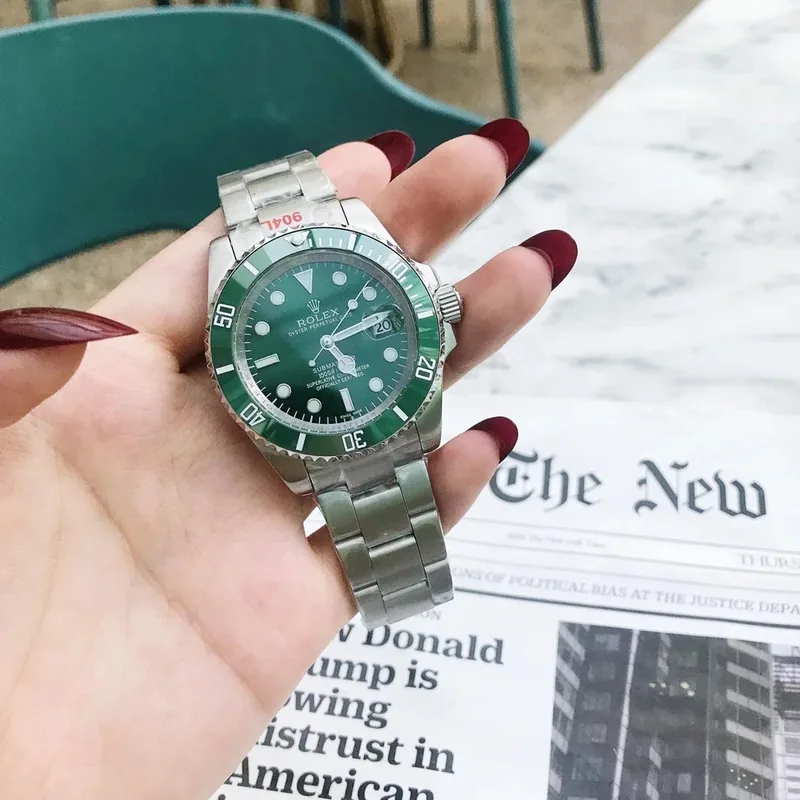
| Rolex Submariner 40mm | Green bezel and green dial, steel bracelet | $76.70 |
| Rolex Submariner 3-Hand 40mm | Black dial and black ceramic-style bezel, shown on a white glove | $89.49 |
| Rolex Datejust 41mm | White dial, fluted bezel, jubilee-style bracelet, date window at 3 | $89.49 |
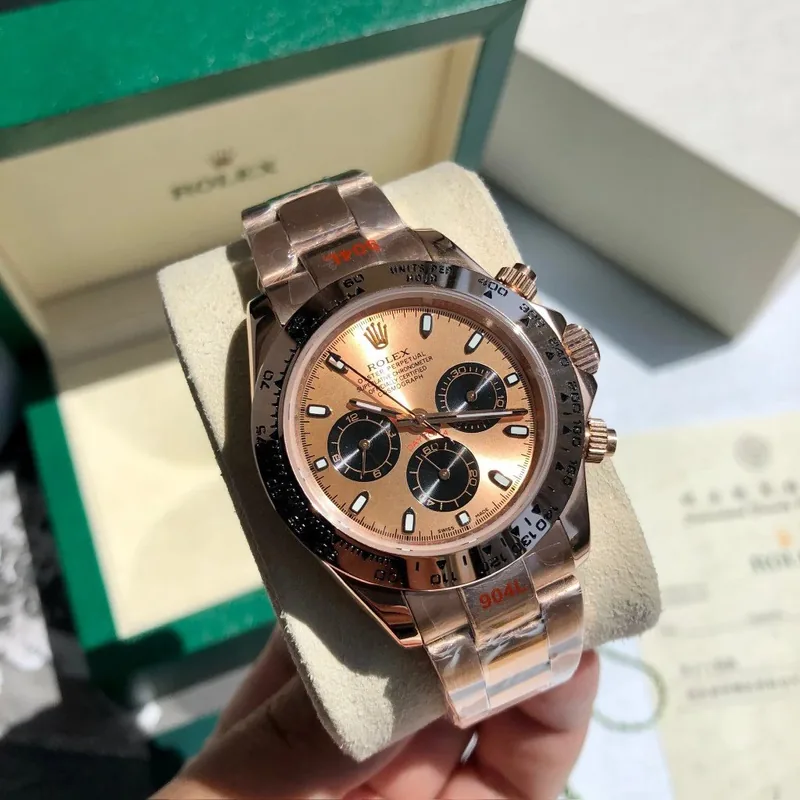
| Rolex Daytona 40mm | Rose gold with three chronograph sub-dials, shown in its box | $89.49 |
| Rolex Yacht-Master 37mm | Dark dial with platinum-look bezel, smaller case | $89.49 |
| Rolex GMT-Master 40mm | Red and blue "Pepsi" 24-hour bezel, steel bracelet | $102.27 |
| Rolex Daytona 40mm (gold) | Yellow gold case and bracelet, dark sub-dials | $121.45 |
| Rolex GMT-Master 40mm (green) | Green dial with a black 24-hour bezel and green seconds hand | $185.37 |
| Rolex Submariner 40mm (gem bezel) | Black dial reading SUBMARINER, multicoloured stone-set bezel | $182.17 |
Note the spread: $70.31 to $185.37 for watches whose originals sit within a much narrower band of each other. Within a single brand, the price here is tracking supplier and photo quality, not model hierarchy.
Cartier, Omega and the shelf's biggest matched pairs
Cartier is 72 listings and Omega 70, and both are worth looking at specifically because they are where the automatic-versus-quartz comparison is most honest — real Cartier and real Omega genuinely sell both movements in the same model lines, so the catalogue is not inventing the distinction. It just is not pricing it.
| Pick | What the photo shows | Price |
|---|---|---|
| Cartier Ballon Bleu 42mm | A matched pair on black leather straps, Roman numeral dials | $51.14 |
| Omega Speedmaster 42mm (quartz) | White bioceramic-look chronograph on a velcro strap — the Swatch collaboration, where quartz is the correct answer | $83.10 |
| Cartier Ballon Bleu 42.1mm | Steel bracelet, Roman dial, the distinctive crown guard at 3 o'clock | $83.10 |
| Omega Constellation 24mm | Small two-tone ladies case with claw-style bezel details | $102.27 |
| Cartier Panthère | Square gold-tone case on a link bracelet, held in hand | $121.45 |
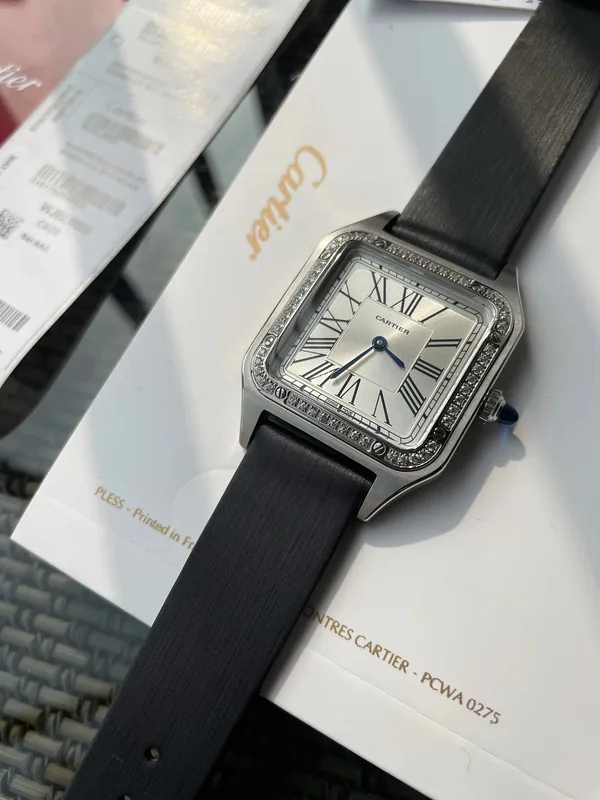
| Cartier Santos | Square case with exposed screws on the bezel, steel bracelet | $127.84 |
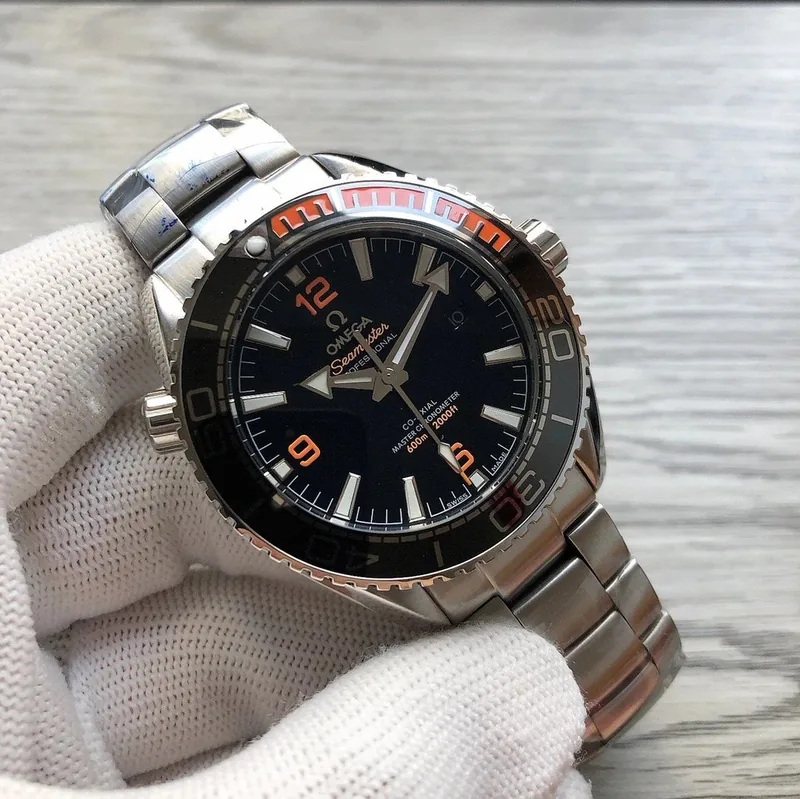
| Omega Seamaster 600 Diver | Black dial diver with orange bezel accents, on a white glove | $191.76 |
The Speedmaster in that table is worth a sentence on its own. It is the Swatch collaboration — a genuinely quartz watch in the real world, sold new for a modest price — and the listing correctly says quartz. It is a small example of the labels tracking the originals rather than being noise.
Audemars Piguet, Patek Philippe, Vacheron Constantin and Panerai
The high end of the shelf, and the place where the price compression is most extreme. Audemars Piguet is 41 listings, Patek Philippe 20, Vacheron Constantin 19, Panerai 16 — and every one of them sits inside the same $50 to $250 band as the Longines and the Tissots.
| Pick | What the photo shows | Price |
|---|---|---|
| AP x Swatch Royal Pop (quartz) | White octagonal case with multicoloured hour markers | $89.49 |
| AP Royal Oak (quartz) | White octagonal case, textured dark dial, exposed bezel screws | $89.49 |
| AP Royal Oak 41mm | Blue chronograph dial, octagonal bezel, integrated steel bracelet | $111.86 |
| Patek Philippe Aquanaut | Black embossed dial, rounded-octagon case, black rubber strap | $121.45 |
| Panerai Luminor 44mm | Cushion case with the hinged crown guard, sandwich dial | $131.04 |
| Vacheron Constantin Overseas 42mm | Blue chronograph dial on a blue rubber strap | $159.80 |
| Panerai Luminor PAM00441 | Brown strap, cream Arabic numerals, crown guard visible | $159.80 |
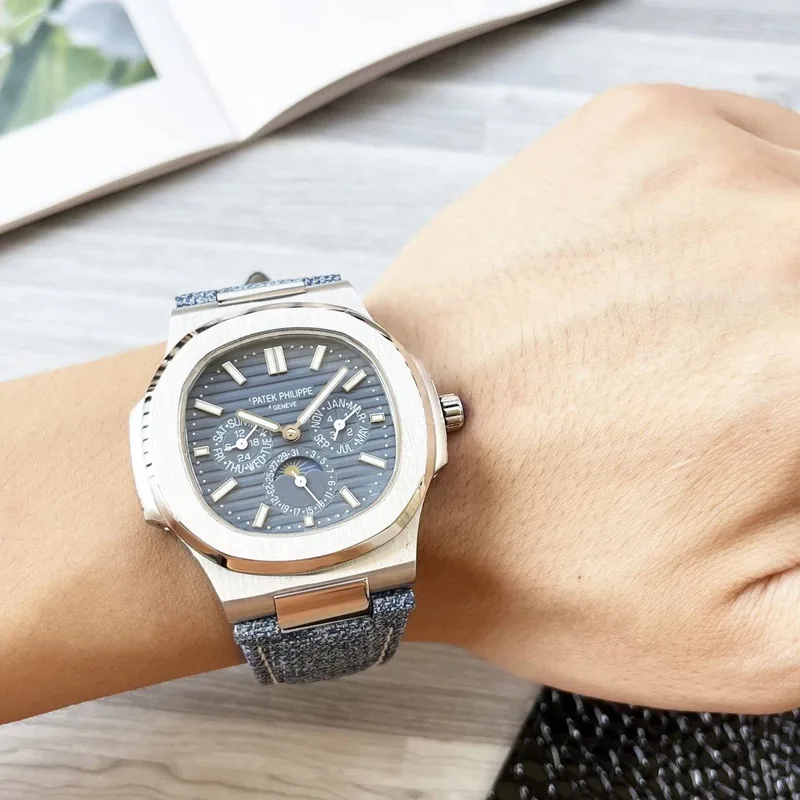
| Patek Philippe Nautilus 42mm | Blue horizontally-embossed dial with moonphase, shown on the wrist | $182.17 |
| Vacheron Constantin Overseas 41mm | Blue dial, integrated bracelet, Maltese-cross bezel profile | $185.37 |
Panerai is 100 per cent automatic across all 16 listings and Vacheron 95 per cent with zero quartz — the two most consistent brands on the shelf, and both correct about their originals.
Longines, IWC and Tissot — where the matched pairs live
Longines is the second-largest brand here at 103 listings, and along with IWC and Tissot it produces the clearest same-model comparisons on the shelf. Note the IWC Portugieser pair in particular: the quartz listing costs $25.57 more than the automatic one.
| Pick | What the photo shows | Price |
|---|---|---|
| Longines La Grande Classique (pair) | His-and-hers set photographed in a Longines box | $57.53 |
| Tissot Le Locle 40mm (automatic) | White Roman-numeral dial, steel case, "Le Locle" on the dial | $76.70 |
| Tissot Le Locle 40mm (quartz) | Same model line, photographed in the box with paperwork — and it costs more than the automatic above | $83.10 |
| IWC Portofino 40mm | Clean white dial dress watch on a dark leather strap | $86.29 |
| IWC Portugieser (automatic) | White dial chronograph with blue hands and Arabic numerals, dial reads AUTOMATIC | $102.27 |
| Longines Master Collection 40mm | White dial with Roman numerals and blued hands, steel bracelet | $111.86 |
| IWC Pilot 40mm | Black pilot dial with triangle at 12, brown leather strap | $127.84 |
| IWC Portugieser (quartz) | Black chronograph dial on a dark strap — $25.57 dearer than the automatic version | $127.84 |
| Tissot Seastar 42mm | Teal dial and matching bezel, steel bracelet diver | $185.37 |
| Longines Conquest 2024 | Four colourways photographed together — white, green, blue and black dials | $239.70 |
That Tissot pair and that IWC pair are the whole argument of this guide in two rows each. Same model line. One says mechanical, one says battery. The battery one costs more.
Casio and G-Shock: where the maths stops working
Nineteen listings, $17.58 to $83.10, median $57.53 — and the one corner of this shelf where we would genuinely suggest you stop and think, for reasons that have nothing to do with quality.
Every other brand here copies something expensive. The gap between what a real one costs and what this shelf charges is what the whole category runs on. A real G-Shock does not sit at the top of a five-figure ladder. It is a mass-market watch sold new with a warranty, a genuine Casio module and a service network — in money that overlaps the range above. When the copy and the original are priced in the same neighbourhood, the argument for the copy largely evaporates. That is not a moral point, it is an arithmetic one.
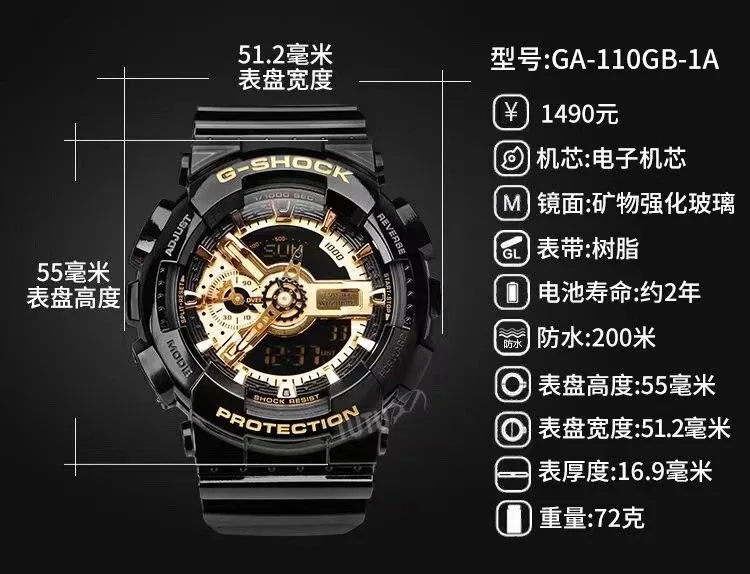
And here is the irony worth the detour. The only listing on this entire shelf that tells you what is inside the watch is a Casio. Its main image is a supplier spec card for a GA-110GB-1A, and it states the movement type, a mineral-reinforced crystal, a resin strap, roughly two years of battery life, 200 m water resistance, a 51.2 mm case width, 16.9 mm thickness and 72 g weight. Nothing else on the shelf discloses any of that.
Why can this one listing afford to be specific? Because on a G-Shock the honest answer and the flattering answer are the same. A real GA-110 is quartz, with a resin strap and a mineral crystal. There is no gap between what the item is and what the buyer hopes it is, so the spec sheet is a selling document rather than an awkward question. Every other listing on this shelf is quiet about its internals, and this is what that silence is shaped like.
| Pick | What the photo shows | Price |
|---|---|---|
| Casio G-Shock GA110 53mm | A supplier sheet of roughly forty colourways — you are choosing from a grid, not a single item | $17.58 |
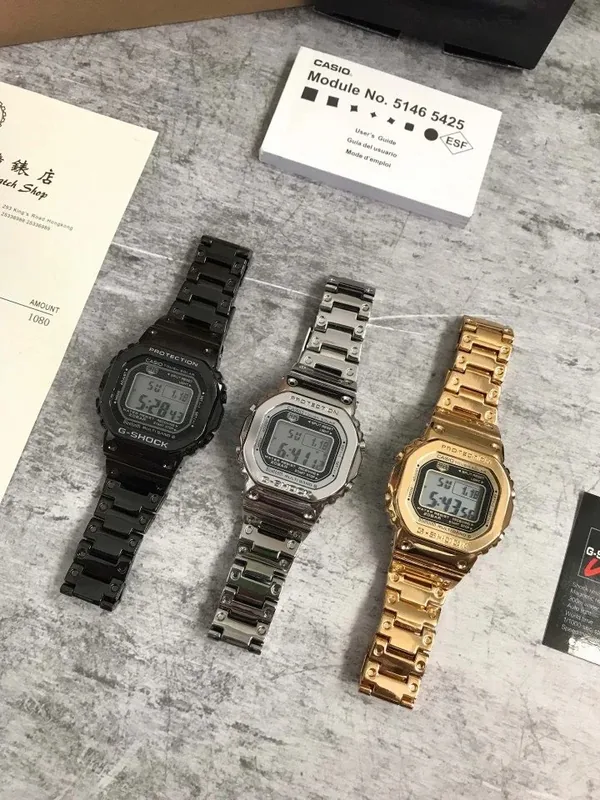
| Casio G-Shock B5000 | Three square-case models side by side in silver, black and gold | $47.94 |
| Casio G-Shock (spec sheet listing) | The spec card described above — movement, crystal, strap, battery life, 200 m, dimensions and weight | $57.53 |
Why the prices tell you nothing
One more piece of shelf-level arithmetic, because it changes how you should read every table above.
Of the 592 watches, 565 — 95.4 per cent — sit between $50 and $250. The median is $121.45. The entire shelf uses only 86 distinct prices across 592 listings, which is what a category priced in bands rather than per item looks like. Meanwhile the originals span from a Casio you could buy with pocket change to a Patek Philippe worth more than a car.
So a Patek Nautilus listing and a Longines listing sit within a few dollars of each other here, while in the real market they are separated by an enormous multiple. The compression is total, and it means price on this shelf carries close to zero information. It will not tell you the tier, it will not tell you the movement, and between two listings of the same model it mostly reflects which supplier photographed it better. Read the image and the video; treat the number as noise.
The ten-second video
Everything above converges on one request, and it is not the request people usually make.
The reason no photograph settles the movement question is not that the photographs are bad. It is that the difference between mechanical and quartz exists only in motion. A mechanical watch drives its seconds hand from a balance wheel oscillating several times a second, so the hand advances in small rapid increments and reads as a sweep. A quartz movement steps the hand once per second and holds it there, so it ticks and visibly pauses. Photograph either one and you get a hand pointing at a number.
So: ask for ten seconds of video of the dial, watch held still, seconds hand running. That is the whole check. It costs an agent almost nothing, it requires no expertise from you, and it settles the single most expensive claim in the listing before any money moves. Our QC photos guide covers how to word requests like this; this is the category where it is worth insisting.
Three supporting requests, in order of value:
- A photo of the actual item, in hand, with something ordinary for scale. This confirms the case diameter the title claims — and, given that twelve listings on this shelf use borrowed images, confirms the seller is photographing the item at all rather than forwarding a catalogue picture.
- A shot through the caseback if it has a display back. Many of these do. A caseback video of a rotor turning is the most complete answer available, and it takes the same ten seconds.
- Ask whether it arrives running. A mechanical watch that has sat in a warehouse will have stopped, and a stopped watch tells you nothing until somebody winds it. Knowing that in advance saves an unnecessary panic on arrival.
What we left out, and why
We examined 55 candidate listings for this guide and rejected 16 — 29.1 per cent — every one after opening its image at full resolution. That rate is in line with what we find elsewhere on this site, and the reasons are worth publishing because they are the same reasons a listing will disappoint you.
Borrowed images. The twelve screenshots described above, plus their relatives.
Model names on the wrong watch. A "Patek Philippe Nautilus" photographed as an Aquanaut — different case, different dial, different strap. A "Rolex Datejust 41mm" whose dial reads OYSTER PERPETUAL and has no date window, which is precisely the thing a Datejust is named for. A "Vacheron Constantin Patrimony" showing a seconds aperture the Patrimony does not have. A "Cartier Ballon Bleu 44mm" photographed as an openworked skeleton watch — ironically the one image on the shelf where you can see the movement, and it is attached to the wrong model name.
Not product photographs at all. A Longines listing whose image is a studio portrait of a model, the watch a few pixels wide on her wrist. An Audemars Piguet listing whose image is a lookbook sheet of eight different watches with Swiss-franc prices printed under them.
And the one we will remember: an "IWC Portugieser Automatic Watch 49mm" whose product photograph is an Apple Watch Ultra — screen lit, Apple logo showing, on a green fabric loop. A titanium smartwatch, listed as a 49 mm Swiss mechanical chronograph. The two things share a case diameter and nothing else.
We mention these individually rather than silently dropping them because the pattern is the lesson: on this shelf the title and the image are maintained by different processes and are not checked against each other. Where the two disagree, believe the image — and where the image is a screenshot, believe neither.
Related guides
- Best reps jewellery — the plating and nickel rules, and the two-week skin test
- Best reps tech — where smartwatches sit, and why battery products are a different risk tier
- Kakobuy shipping guide — weight brackets and what small dense parcels cost
- Best Kakobuy finds — the full guide index
Frequently asked questions
What is the one thing I cannot check on a reps watch?
The movement, and it is the only specification these listings actually state. We counted every watch in this catalogue on 14 August 2026: 592 listings, of which 404 put the word "Automatic" in the title and 130 put "Quartz". That is 68.2 per cent making a mechanical claim about a component sealed inside a steel case. In every other category on this site the title describes something the photograph can show you — a colour, a crest, a sleeve. Here the title describes the one part the photograph structurally cannot reach. An automatic movement is a mainspring wound by a rotor; a quartz movement is a battery driving an oscillator. They cost very different amounts to make, they behave differently, and from a still image of the dial they are indistinguishable. This guide is mostly about what to do with that fact.
How can I tell automatic from quartz before I pay?
Ask for video, not photographs. This is the single most useful request in this category and almost nobody makes it. A mechanical watch drives its seconds hand through a balance wheel beating several times per second, so the hand appears to sweep in small rapid steps. A quartz movement steps the hand once per second, so it ticks visibly and pauses. That difference exists only in motion — no still photograph of any resolution contains it, which is why the standard QC photo set cannot settle the claim the title is making. Ten seconds of video of the dial, with the watch held still, answers it completely and costs an agent almost nothing to shoot. Ask for the seconds hand specifically. If the listing says automatic and the hand ticks once per second, the listing is wrong, and you have found that out before paying rather than after.
Does paying more get me a mechanical movement instead of a battery?
On this shelf, no, and we can show that with the catalogue's own prices. We grouped all 592 watches into model families and found 22 families that carry both an "Automatic" listing and a "Quartz" listing — the same model line, both movements, side by side. In 11 of those 22 families the quartz median is equal to or higher than the automatic median. Seven families price them identically to the cent: Cartier Tank $121.45 against $121.45, Cartier Panthère $127.84 against $127.84, Omega Speedmaster $121.45 against $121.45, Longines PrimaLuna $127.84 against $127.84, Longines DolceVita $121.45 against $121.45, Cartier Tank couple sets $121.45 against $121.45, and Tissot Le Locle $83.10 against $83.10. In four more the battery version costs more: Cartier Santos automatic $121.45 against quartz $159.80, a $38.35 premium for the battery. Across the whole shelf the automatic median is $121.45 and the quartz median $108.66 — a gap of $12.79. In the real watch market that same distinction is worth hundreds to thousands of dollars. Here it is worth twelve dollars and seventy-nine cents, and half the time it is worth nothing or less than nothing. Price does not encode the movement.
Are the product photos actually photos of the watch being sold?
Not always, and this is the finding we would most want a buyer to take away. Phone screenshots have a distinctive tall shape, so we measured the aspect ratio of all 592 main images and found 14 taller than 1.7:1. We then opened all 14. Twelve of them are screenshots of somebody else's web page showing the genuine watch. Seven are from xbiao.com, a Chinese watch price database — one of them, an Audemars Piguet Royal Oak listing, still has the reference 15400ST.OO.1220ST.01 and the list prices ¥132,000, ¥134,000 and $16,900 visible in the frame. Two are screenshots of Longines' own official website, one still showing ¥12,200.00 next to the watch. One is from Omega's official site. One is a Tmall product page for a Tissot Le Locle, complete with the ¥4,320.00 price and the "add to cart" buttons. The other two of the 14 are genuine: one supplier variant sheet and one ordinary hand-held photo. So on at least twelve listings, the image is not a photograph of the item you would receive — it is a picture of the real watch, borrowed from a retailer. You cannot assess a movement, or anything else, from a photograph of a different watch.
Which brands are on the shelf and in what numbers?
Rolex is the largest at 134 listings, then Longines 103, Cartier 72, Omega 70, Audemars Piguet 41, Tissot 21, IWC 21, Patek Philippe 20, Casio and G-Shock 19, Vacheron Constantin 19, Panerai 16, Armani 9 and Apple 7. Only 33 of the 592 — 5.6 per cent — carry no recognisable brand in the title, which makes this a far more legible shelf than the sneaker one, where most titles say nothing at all. Model names are present too: 127 of the 134 Rolex listings name a model, with Datejust 33, Daytona 29, Submariner 25, Yacht-Master 21 and GMT-Master 15. That matters practically, because it means you can search this category by model and get a meaningful answer, which is not true everywhere on this site.
Do the automatic and quartz labels track reality at all?
At brand level, yes — which is worth saying plainly, because the rest of this guide is sceptical and the scepticism should be aimed at the right target. The share of listings claiming automatic varies by brand in the direction you would expect if someone were paying attention: Panerai 100 per cent, Vacheron Constantin 95 per cent, Patek Philippe 90 per cent, Tissot 90 per cent, IWC 90 per cent, Rolex 85 per cent, Audemars Piguet 78 per cent, Omega 69 per cent, Longines 62 per cent, Cartier 60 per cent. Rolex shows zero quartz listings, which is right in spirit — Rolex has not sold a quartz model in decades. Cartier sits at 60 per cent automatic and 39 per cent quartz, which is also right, because real Cartier Tanks and Santos genuinely come both ways. Casio is 0 per cent automatic and 100 per cent quartz, which is correct, because real G-Shocks are quartz. So the labels are not random noise. They track the originals. What they do not do is tell you what is inside the specific watch in the box, and the pricing shows the shelf itself does not treat the distinction as worth money.
Is a reps G-Shock worth buying?
This is the one corner of the shelf where we would tell you to think hard, and the reason is arithmetic rather than ethics. Every other brand here is a copy of something that costs thousands. A real G-Shock does not. The 19 Casio and G-Shock listings here run $17.58 to $83.10, with a median of $57.53 — and real G-Shocks are sold new, with a warranty, a genuine module and Casio's own service network, in overlapping money. The saving that justifies a rep of a five-figure watch simply is not there. There is also a nice irony in this corner: the single most informative image in all 592 listings belongs to a Casio. It is a supplier spec sheet for a GA-110GB-1A that states the movement type, mineral-glass crystal, resin strap, roughly two-year battery life, 200 m water resistance, 51.2 mm case width, 16.9 mm thickness and 72 g weight. It is the only listing on the shelf that tells you what is inside — and it can afford to, because on a G-Shock the honest answer is the same as the original's.
How many of these listings did you reject, and why?
We examined 55 candidates and rejected 16, which is 29.1 per cent. Every one was rejected after opening its product image at full resolution. The reasons split three ways. Some are the borrowed screenshots described above. Some are model names attached to the wrong watch: a "Patek Philippe Nautilus" photographed as an Aquanaut, a "Rolex Datejust" photographed as an Oyster Perpetual with no date window at all, a "Vacheron Constantin Patrimony" photographed as a model with a seconds aperture the Patrimony does not have, a "Cartier Ballon Bleu" photographed as an openworked skeleton watch. And some are not product photographs at all: a model portrait in which the watch is barely visible, and a lookbook sheet of eight different watches. The most memorable single rejection is an "IWC Portugieser Automatic Watch 49mm" whose product image is an Apple Watch Ultra, screen lit, Apple logo showing, on a green fabric loop. We have listed none of these. Everything in the tables below was confirmed live and confirmed from its own photograph.
Why is the price range so narrow when the originals are not?
Because the shelf is priced as a category, not as a set of individual products, and once you see it you cannot unsee it. Of the 592 watches, 565 — that is 95.4 per cent — sit between $50 and $250. The whole shelf uses only 86 distinct prices. Meanwhile the originals these copy span from a Casio you can buy for pocket money to a Patek Philippe that costs more than a house deposit. The compression is total: a Patek Nautilus listing and a Longines listing sit within a few dollars of each other here, while in the real market they are separated by an enormous multiple. The practical consequence is that price carries almost no information on this shelf. It will not tell you which tier you are in, it will not tell you the movement, and it will not reliably tell you which of two listings is better made. Assume price is close to noise here and judge on the image, the video and what the agent confirms in writing.
What should I ask for before I pay?
Three things, in order of value. First, ten seconds of video of the dial with the seconds hand running — this settles the automatic-or-quartz question, which is the most expensive claim in the listing and the only one no photograph can answer. Second, a photograph of the actual item next to something ordinary for scale, which both confirms the case size the title claims and confirms the seller is photographing the item rather than forwarding a catalogue picture; given that twelve listings here use borrowed images, this is not a paranoid request. Third, if the watch is automatic, ask whether it arrives running and whether it has been wound — a mechanical watch that has sat in a warehouse will be stopped, and a stopped watch tells you nothing until someone winds it. Also ask the caseback question: many of these have display casebacks, and a photograph through the caseback of the movement in motion is the most complete answer you can get.
Anything else worth knowing before ordering a watch specifically?
Two practical things beyond the movement. Watches are dense and small, so freight is rarely the problem it is for a puffer jacket, but they are also the category where declared value and packaging matter most — our shipping guide covers how the weight brackets work. And branded watches attract more attention at borders than most categories of clothing do, which is worth factoring into your expectations rather than discovering later. Beyond that, the ordinary advice applies: buy the model you actually want rather than the cheapest listing in the family, because the price spread within a model line here reflects supplier and photo quality more than it reflects specification.