
Best Reps Kids Football Kits on Kakobuy
Nearly every children's football listing in this catalogue is titled Jersey. We opened twenty-four of them one at a time to write this guide, and not one contained a jersey. Twenty were a shirt and a pair of shorts. Four were a shirt, shorts and socks. The title names one garment; the photograph shows two or three. That sounds like a small annoyance and it is actually the most expensive detail on the page, because it decides which official price you should be measuring against — and the gap between a junior shirt and a junior kit at Nike and adidas is wide enough to change the answer entirely. This guide ranks the kids kits worth buying on Kakobuy Drop, all of them $14.06, tells you what is in each parcel, and then covers the three things about buying football kit for a child that no spreadsheet mentions: why the year in the title is fiction, why the same child is an XL and an XS on two charts from the same brand, and which safety rules genuinely change when the wearer is seven.
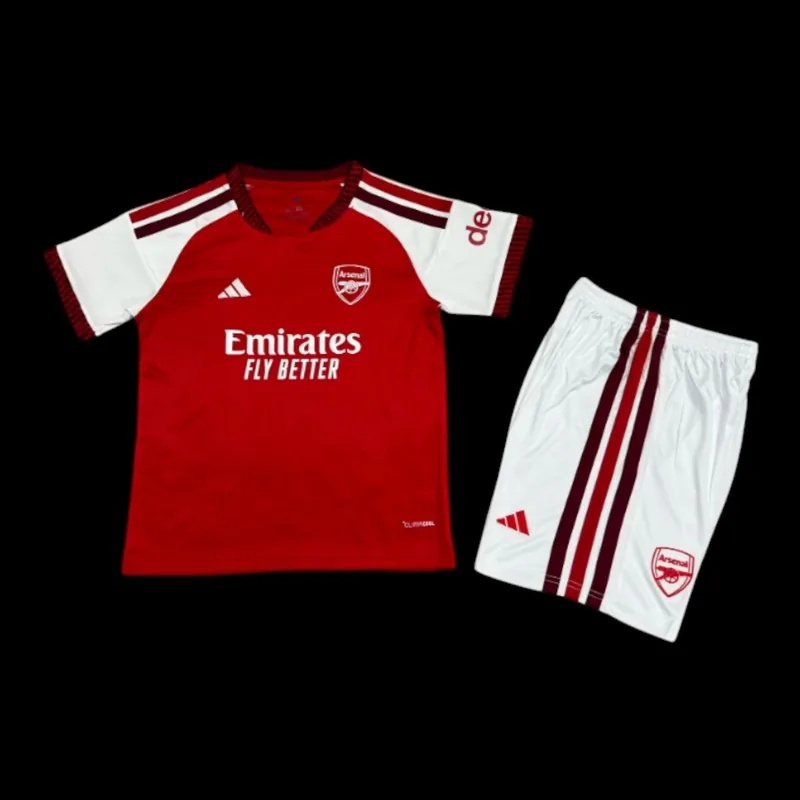
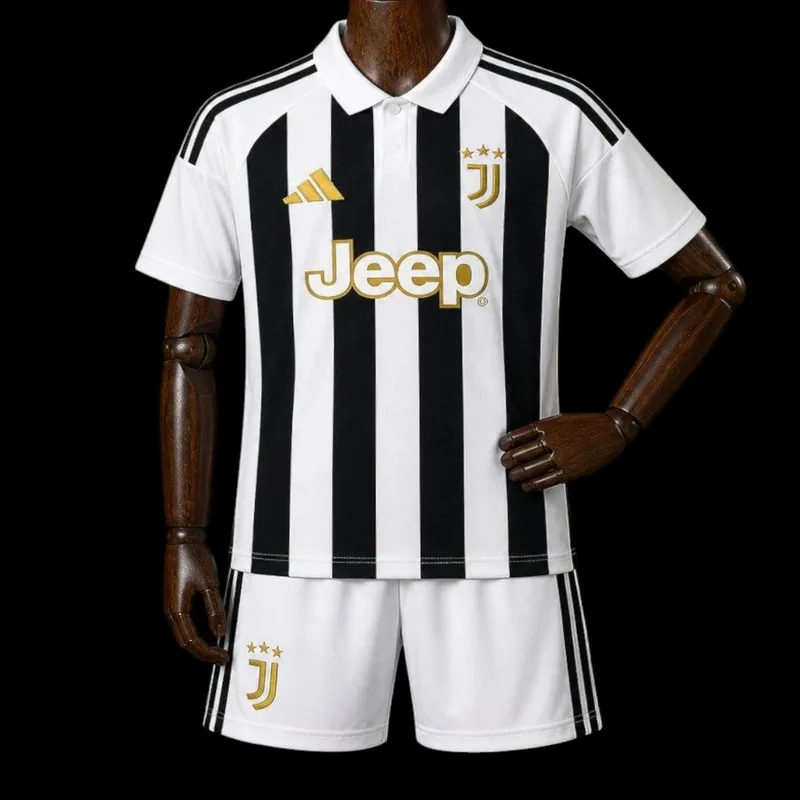
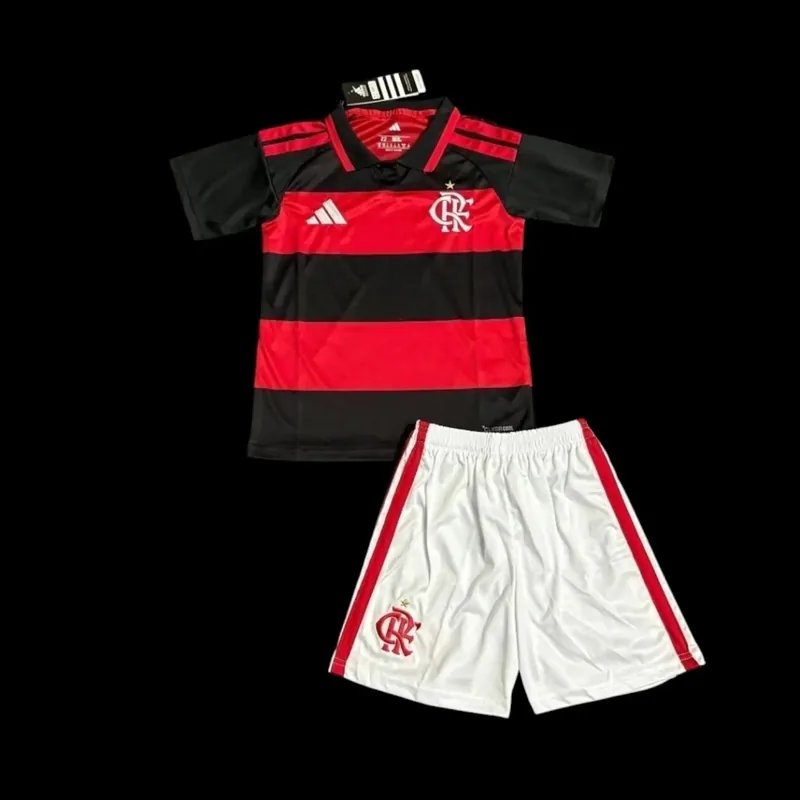
Which reps kids football kits are actually worth buying?
Every kit below was confirmed live before publishing and every one was confirmed from its own single-product photograph — specifically, confirmed for how many garments it contains, which is the column no other guide on this site needs. They are grouped by cycle, because the current-season shelf here is unusually well stocked.
Browse more football kit and teamwear →
Prices are the live Kakobuy Drop prices at the time of writing and move with the catalogue. Club and country names describe the kit a piece is modelled on. The "in the parcel" column records what the listing's own product photograph shows, counted garment by garment.
Count the pieces before you compare the price
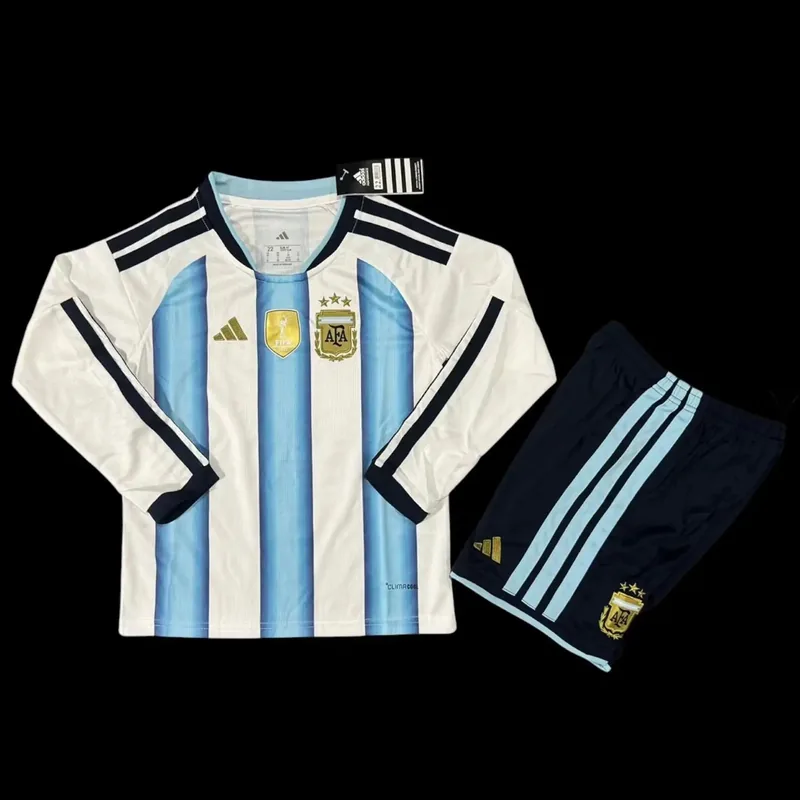
There are 893 children's football listings in this catalogue and all 893 are $14.06. That is a genuinely flat shelf — a 1998 Japan retro kit and a brand-new 2026/27 Arsenal kit cost the same. So the only variable on our side is what comes in the parcel, and the titles do not tell you. Every listing we opened said "Jersey" and every listing we opened showed at least two garments.
On the official side the same ambiguity exists, except there it is priced. Nike sells the same 2026/27 Barcelona away shirt across five brackets, and we pulled all five on 5 August 2026 at full price with no discount running:
| Bracket | What you get | Nike price |
|---|---|---|
| Baby / Toddler | Three pieces — shirt, shorts, socks | $80 |
| Little Kids' | Three pieces — shirt, shorts, socks | $85 |
| Big Kids' | One piece — shirt only | $90 |
| Men's / Women's | One piece — shirt only | $100 |
| Men's Match (authentic) | One piece — shirt only | $175 |
Read that column twice, because it runs the opposite way to intuition. The cheapest bracket contains the most garments. A three-piece kit for a toddler is $80; the shirt alone, one bracket up, is $90. adidas does the same thing — a Liverpool 26/27 two-piece baby kit was $70 while the same club's single kids jersey was $80. Nobody is charging you extra for the shorts. Younger simply costs less, and the shorts and socks come along.
One more thing about those official prices applies only to children: they hold. Nike's kids kit pages carry the line "This product is excluded from site promotions and discounts", and a sale was running the day we checked. Adult and end-of-cycle stock goes into the markdowns — we watched adidas take its Germany kids jersey to half price and Argentina's to thirty per cent off as clearance — but current-cycle kids kits at Nike sit outside the promotional machinery entirely. The gap between official and replica is therefore at its widest for children exactly when everything else is on sale.
Which means the comparison you make determines the answer you get. Set our $14.06 against an adult replica shirt at $100 and you get a seven-times saving. Set it against the thing it actually is — a multi-piece children's kit, which official brands sell at $70 to $85 — and it is closer to five or six times. Both numbers are true about different products. Only the second one is honest, and we would rather print the smaller number than the flattering one. It is the same arithmetic lesson as our Stussy guide, where checking the price ladder first turned out to matter more than checking the stitching.
The year in the title is a search term, not a specification
A lot of these listings carry a season or a tournament year. Very few of them earn it. The titles are generated from a supplier feed rather than written by anyone who looked at the garment, and the catalogue proves it on its own: 59 of the children's listings name the country in French next to the English ones. Argentina and Argentine. England and Angleterre. Germany and Allemagne. South Africa and Afrique du Sud. Those are separate products with separate photographs, not duplicates — but a feed that cannot settle on one language for a country name is not a feed that has verified what season a shirt is from.
You can see the consequence in the photographs. The listing titled Germany 2026 pictures the white shirt with the black, red and gold chevron slashed across the chest — the 1990 design, one of the most recognisable shirts in the sport. The listing titled Mexico 2026 pictures the green shirt printed with the Aztec sun stone, which is 2022. The one titled England 2026 pictures a shirt whose inner neck tape reads HAPPY AND GLORIOUS, the inscription used on the Euro 2024 home shirt.
None of that makes them bad kits. The 1990 Germany shirt is a better-looking garment than most things released since, and a seven-year-old wants the shirt that looks right, not the shirt with the correct release date. It does mean one thing for how you shop: buy from the photograph and treat the year as noise. If you specifically need this season's kit because the child will be photographed in it next to friends who have the real one, open the image and compare it against the club's current shirt before you order — do not trust the number in the title to do that job for you.
One child, two charts, opposite letters
Sizing for children is normally described as the easy part — measure the height, pick the band. It is easy right up until the letter codes get involved, and football kit is where they collide worst. Both of these charts are Nike's own, published on the same site:
- Little Kids' soccer clothing: XS is 96–104 cm, and XL is 122–128 cm, listed against an average age of seven to eight.
- Boys' clothing: XS is 48–50 inches — the same 122–127 cm — listed against an average age of seven to eight.
The same child, in the same week, is an XL in one Nike range and an XS in the other. There is nothing wrong with either chart; they are consecutive rather than overlapping, and each is internally consistent. But it means a letter on its own carries no information until you know which range produced it. Nike's own instruction on the page is to use height, with age given only as an average.
adidas is more legible: its kids sizes run XS 123–128 cm, S 135–140, M 147–152, L 159–164 and XL 171–176 — twelve centimetres a step, which is exactly where the European 128 / 140 / 152 / 164 / 176 labelling comes from. And our own listings sidestep letters altogether. The QC photographs show neck labels printed with a bare 22 on one kit and 24 on another, with no letter and no age anywhere on the tag. Those are height-derived numbers in the Chinese system, and our football jersey size guide and height and weight chart both give the conversion. The rule that survives all three systems is the same one: measure the child, work in centimetres, and buy the band above the measurement rather than the one it lands in.
The rules that exist only because the wearer is a child
This is the one category on the site where regulation keys off the person wearing the garment rather than the garment itself. It is worth knowing what those rules actually say, partly because they are narrower than people assume and partly because the two rules most often cited at replica kits do not apply at all. What follows is a description of published standards, not legal advice.
Drawstrings are the real one, and the US and EU disagree about shorts. In the United States, 16 CFR 1120 places children's upper outerwear with certain drawstrings on the Substantial Product Hazard List. Hood and neck drawstrings are prohibited outright in sizes 2T to 12; waist and bottom drawstrings in sizes 2T to 16 are limited to three inches outside the channel with the garment fully expanded, with no toggles or knots on the free ends and bartacking if the cord is continuous. The CPSC adopted it after 56 reported neck and hood entanglements, the majority of them snagging on playground slides. But the rule defines upper outerwear as jackets and sweatshirts and states plainly that "pants, shorts, and skirts are not intended for the upper portion of the body and are excluded from the scope of the Standard." So the cord in a pair of football shorts is outside the American rule.
Europe draws the line elsewhere. EN 14682 applies to children's clothing generally rather than outerwear only, up to age fourteen, and its clause 3.4 covers the chest and waist area — precisely where football shorts have their drawstring. For a young child, defined as up to age seven or 134 cm, drawstrings and functional cords in the head, neck and upper chest area are not permitted at all, and decorative cords there are limited to free ends of 7.5 cm with no knots or toggles. That divergence is the sharpest single difference between the two jurisdictions for a shirt-and-shorts set: the same pair of shorts is out of scope in one and in scope in the other.
The lead rules land on the printing, which is the whole product. Under 16 CFR 1500.91 plain textiles are treated as not exceeding the lead limits and are exempt from third-party testing — the list covers natural fibres and manufactured fibres including polyester, which is essentially what every football kit is made of. The exemption then stops: it does not extend to "after-treatment applications, including screen prints, transfers, decals, or other prints." A replica kit is an exempt polyester base carrying a crest, a squad number, a competition badge and a sponsor logo, none of which are exempt. The decoration is simultaneously the reason the garment exists and the part with a genuine testing obligation attached. Separately, CPSA section 14(a)(5) requires permanent marks on a children's product and its packaging that let a buyer identify the manufacturer, the production location and date and the batch. A polybagged replica typically carries none of that, which is an observable absence rather than an accusation.
And two rules that do not apply, despite being cited constantly. The phthalate limits at 16 CFR 1307 govern children's toys and child care articles; a shirt and shorts are neither, so those limits are simply not engaged unless something else ships in the bag. The children's sleepwear flammability standards at Parts 1615 and 1616 cover garments intended primarily for sleeping, which a football kit is not. General apparel flammability under Part 1610 does apply — to adult clothing equally — and exempts polyester at any weight in any case. If you see a page telling you replica kids' kits fail phthalate or sleepwear standards, that page has not read the standards.
The practical version of all this is short. Look at the cords before the child wears it. If a hooded top in the set has a cord at the hood or neck and the child is small, take it out — that is the exact configuration both regulators moved against, and it is prohibited outright on an official garment in that size. Check that any waist cord is short, carries no toggle or knot, and cannot be pulled free of its channel. Those two checks take a minute and cover the hazard the rules were actually built around.
Kids kit is the freshest part of this catalogue
Everywhere else on this site we have to admit that the shelf runs a cycle behind the official one. Here it does not, and it is worth saying so with numbers. Of the 893 children's football listings, 178 — one in five — are 2026/27, the current cycle, and another 200 are 2025/26. Across the adult football shelf, 2026/27 accounts for 904 listings out of 7,662, which is under one in eight. Proportionally the children's shelf is around twice as current as the adult one.
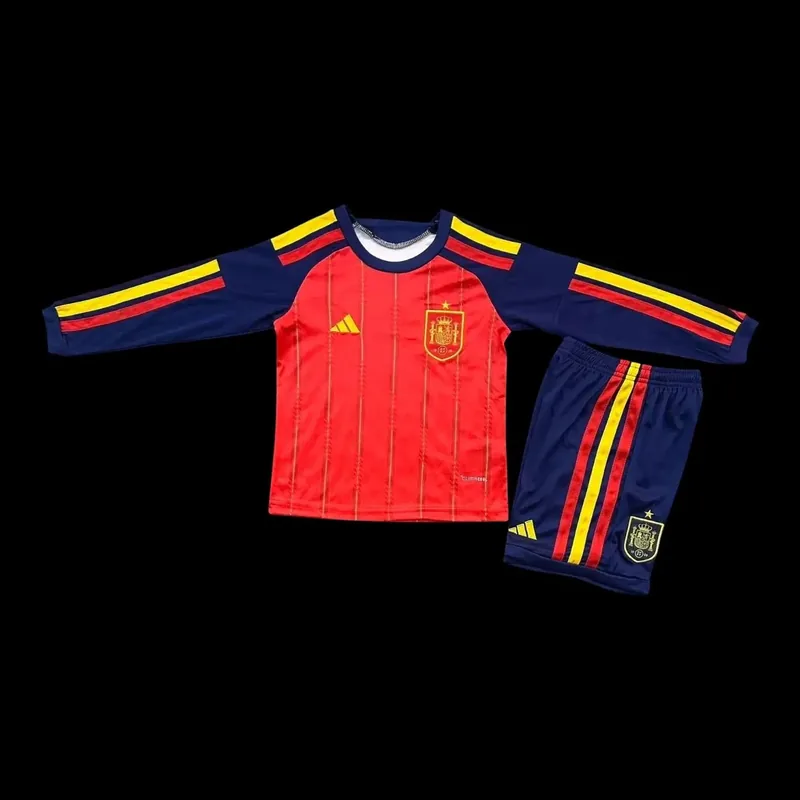
That is a real advantage for the buyer with a seven-year-old, because a child noticing that their shirt is last season is a much more likely event than an adult caring. If you want the current cycle, the current cycle is unusually well stocked here — Arsenal, Juventus, Flamengo, Spain and Argentina at the top of the table above are all 26/27, and the goalkeeper kit is too.
When to buy the real one
Three cases, and they are narrower than on most of our pages.
If the kit is for organised football. Registered youth teams generally require the club's own strip, and a replica of a professional club's kit is not that. This is a rules problem rather than a quality problem, and no amount of stitching accuracy solves it.
If the child is under about three. The smallest brackets are where the official pricing is least punishing — Nike's baby three-piece was $80 and adidas's baby two-piece kit $70 — and where the garment is closest to the skin for the longest each day. Against $14.06 that is still a real saving, but it is the point on the curve where paying it buys the most.
If the name and number matter to the child. Officially printed personalisation is priced accordingly — a pre-printed Enzo Fernández Chelsea shirt for a big kid was $120 against $90 plain, and an adidas kids Messi shirt $110 against $80. That is a large premium for lettering, and our printing and patches guide covers how the equivalent is applied on a replica. But if a seven-year-old has decided the point of the shirt is the name on the back, get the name right, because that is the entire product as far as they are concerned.
Outside those three, the case for the replica is stronger for children than for adults, and not for the reason people expect. The multiple is smaller here, not bigger, because the official brands already price down for children. What tips it is the expiry date. An adult shirt gets worn for years. A child's kit fits for perhaps a season before the height band moves, and it spends that season being slid across gravel. Buying a garment with a twelve-month working life at $14.06 rather than $80 is not really an argument about arbitrage. It is an argument about how much you want to spend on something that is going to be outgrown before it is worn out.
Frequently asked questions
How much does a reps kids football kit cost on Kakobuy?
Every single one is $14.06. We checked all 893 children's football listings in the catalogue and the price histogram has exactly one entry — a 1998 Japan retro kit, a 2026/27 Arsenal kit and a 2026 Brazil kit are all the same $14.06. What varies is what arrives in the parcel: most listings are a shirt and shorts, and some are a shirt, shorts and socks. For comparison, the official versions of the same thing were $80 for a Nike baby three-piece kit, $85 for a Nike little-kids three-piece kit and $70 for an adidas two-piece baby kit when we checked on 5 August 2026.
Does a kids football kit listing include the shorts, or just the shirt?
Almost always the shorts too, even though nearly every listing is titled "Jersey". We opened 24 listings one at a time for this guide and every one of them pictured more than one garment — 20 were a shirt and shorts, and four also included socks. Not one was the single shirt the title names. This matters for more than expectations: it decides which official price you should be comparing against. A junior shirt on its own was $90 at Nike and $80 at adidas, while the multi-piece kits were $80–$85 at Nike and $70 at adidas. Comparing our $14.06 kit against a shirt-only price flatters the deal; comparing it against the kit price is the honest number.
Why does the listing say 2026 when the shirt in the photo is older?
Because the year in these titles is a search term, not a specification. The titles come out of a supplier feed rather than being written by anyone who looked at the garment — you can see that directly in the catalogue, where 59 of the children's listings name the country in French alongside the English ones, so Argentina and Argentine, England and Angleterre, Germany and Allemagne all sit side by side as separate products. Several listings labelled 2026 picture designs from earlier tournaments: the one titled Germany 2026 shows the white shirt with the black, red and gold chevron across the chest from 1990, and the one titled Mexico 2026 shows the green shirt with the Aztec sun-stone print from 2022. The reliable field is the photograph. Read it and ignore the year.
What size kids football kit should I order?
Order by the child's height in centimetres, and check which size system the listing is using before you pick a letter. This is the one category where letter sizes actively mislead, because the same child sits at opposite ends of two different official charts. On Nike's own charts, a seven-to-eight-year-old is XL in the Little Kids range (122–128 cm) and XS in the Boys range (48–50 inches, which is the same child). One letter, two products, opposite ends. adidas is cleaner: its kids XS through XL map to 123–128, 135–140, 147–152, 159–164 and 171–176 cm, which is where the European 128 / 140 / 152 / 164 / 176 numbering comes from — twelve centimetres per step. Our listings use bare numbers instead: the QC photos show neck labels reading 22 and 24 with no letter anywhere. Our football shirt size guide and our height-and-weight chart both cover the conversion in detail.
Are there safety rules for children's kits that do not apply to adult shirts?
Yes, and they are narrower and more specific than most people assume. The clearest is drawstrings. In the US, 16 CFR 1120 makes hood and neck drawstrings on children's upper outerwear in sizes 2T to 12 a substantial product hazard outright, and limits waist and bottom drawstrings in sizes 2T to 16 to three inches outside the channel with no toggles or knots on the free ends. The CPSC wrote that rule after 56 reported neck and hood entanglements, mostly on playground slides. But it expressly excludes pants, shorts and skirts, so the cord in a pair of football shorts sits outside it. Europe is the opposite: EN 14682 covers children's clothing generally rather than outerwear only, and its clause 3.4 covers the chest and waist area, which is exactly where football shorts have their cord. For a child under seven it prohibits drawstrings and functional cords in the head, neck and upper chest area altogether. That US-versus-EU split is the single sharpest difference for a shirt-and-shorts set.
Which parts of a kids kit have a real testing obligation behind them?
The printed parts — which is to say the parts you are actually buying. Under the US lead rules, plain textiles get an exemption from third-party lead testing: 16 CFR 1500.91 lists natural and manufactured fibres including polyester as materials determined not to exceed the limits. But that exemption expressly does not extend to "after-treatment applications, including screen prints, transfers, decals, or other prints". A replica kit is a polyester base, which is exempt, carrying a crest, a squad number, a league badge and a sponsor logo, which are not. The decoration is both the reason the shirt exists and the part carrying the obligation. Two rules people expect to apply do not: the phthalate limits in 16 CFR 1307 cover toys and child care articles, and a shirt is neither; and the children's sleepwear flammability rules in Parts 1615 and 1616 cover garments intended primarily for sleeping, which a football kit is not.
Is the saving on a kids kit as big as on an adult shirt?
No — it is smaller, and it is worth being straight about that. Official brands already discount for children. Nike's price ladder for one shirt, the 2026/27 Barcelona away, ran $100 for the men's and women's versions, $90 for the big-kids shirt, $85 for the little-kids three-piece kit and $80 for the baby three-piece kit, all at full price on 5 August 2026. adidas prices its kids replica at $80 against $100 for the adult. So against an adult shirt our $14.06 is about seven times cheaper, while against a children's kit it is closer to five or six. The argument for buying the replica is not that the multiple is bigger here. It is that the garment has a hard expiry date measured in months, because the child grows out of it long before it wears out.